Category: Sectors

  • Nagaland ropes in Vitamin Angels for child nutrition drive

    Nagaland ropes in Vitamin Angels for child nutrition drive

    The pilot’s formative research is slated to kick off by June-July this year.

    In a bid to tackle malnutrition among children, the Nagaland government has partnered with Vitamin Angels India to roll out a special drive to provide vitamin A supplements and deworming tablets to kids under five years across three districts.

    The National Health Mission (NHM) of Nagaland signed an agreement with the non-profit organisation to undertake the nutrition intervention in Dimapur, Niuland and Chümoukedima districts through 2024-25, an official statement said.

    The project, extending an existing partnership, aims to strengthen nutritional interventions using an “implementation science” approach focused on community needs. An NHM-Vitamin Angels team will monitor the drive.

    Only 46 per cent of Nagaland’s children aged 9-35 months received vitamin A doses as per National Family Health Survey (NFHS)-5 data, much lower than the 71 per cent national average. Vitamin A boosts immunity, and its deficiency can cause blindness and increase disease susceptibility.

    “We’ve made progress in improving nutrition levels but need to do more. This pilot will help address supply-demand gaps,” said Dr Khelito Zhimomi, Joint Director at the state’s Reproductive, Maternal, Newborn, Child, Adolescent Health plus Nutrition (RMNCAH+N) wing.

    Vitamin Angels India’s Shruti Menon stressed the NGO’s commitment to taking services to the “last mile” aided by the state’s resolve.

    The pilot’s formative research is slated to kick off by June-July this year.

    Vitamin A is crucial for boosting immunity and its deficiency can cause blindness, increase susceptibility to diseases like measles and diarrhoea among kids. Guidelines recommend nine doses at six-month intervals for under-five children from nine months of age.

  • Hyundai Motor India gives assistive devices to disabled

    Hyundai Motor India gives assistive devices to disabled

    HMIL plans to provide a total of 684 such devices over three years to aid mobility, vision, hearing and communication of the disabled under the programme run by the Hyundai Motor India Foundation (HMIF) and Samarthanam Trust for the Disabled.

    Hyundai Motor India Ltd (HMIL) has  distributed 72 technologically advanced assistive devices, including hearing aids, wheelchairs and bionic limbs, to disabled people in partnership with an NGO as part of its social initiative “Samarth by Hyundai”.

      HMIL plans to provide a total of 684 such devices over three years to aid mobility, vision, hearing and communication of the disabled under the programme run by the Hyundai Motor India Foundation (HMIF) and Samarthanam Trust for the Disabled.

      The first “Samarth Assistive Devices Conclave” hosted by HMIL saw panel discussions on enabling inclusion through assistive technology, challenges around disability in India and investment in technologies for para sports.

      “We aim to create a more inclusive society and ease the way of living for people with disabilities in India,” Tarun Garg, chief operating officer at HMIL, told the event.

      The automaker said its global vision of “Progress for Humanity” was aligned with the initiative to empower the disabled.

      Mahantesh G Kivadasannavar, founder of Samarthanam Trust, said the collaboration created “an inclusive society where technology and compassion converge to enhance the lives of people with disabilities”.

  • Underprivileged kids in Gurugram’s Bhawani Enclave to get schooling via foundation project

    Underprivileged kids in Gurugram’s Bhawani Enclave to get schooling via foundation project

    The project, located in Bhawani Enclave near Basai village, will provide non-formal education to 150 children aged 6 to 14 years from migrant worker families who are currently not enrolled in schools.

    Whiteland Foundation announced on Monday it has adopted a school for underprivileged children in Gurugram in collaboration with BG Foundation, marking its first major initiative in the child education sector.
    The project, located in Bhawani Enclave near Basai village, will provide non-formal education to 150 children aged 6 to 14 years from migrant worker families who are currently not enrolled in schools, the foundations said in a joint statement.

    It was inaugurated by Whiteland Foundation trustees Priyanka Sardana and Karishma Kaul Babbar.

    “Education is the birthright of every child,” said Kaul Babbar. “Our adoption of this school and commitment to providing quality education will have a transformational impact on society.”

    The long-term initiative spanning 3-5 years aims to integrate the children into the formal schooling system. It will also feature a computer centre to teach basic computing skills.

    Teachers from the local community will conduct baseline assessments of students’ educational levels and start with building rapport and interest before formal lessons based on structured modules.

    BG Foundation currently operates two schools accommodating 150 students and focuses on education, skill development and disaster management for disadvantaged children and youth.

  • Hinduja Group, BML University to train rural women as entrepreneurs in Alwar

    Hinduja Group, BML University to train rural women as entrepreneurs in Alwar

    In the first phase, 30 women will receive training to launch micro-businesses.

    Five years after completing a sustainable water management project in Alwar district of northwestern Rajasthan state, two companies and a local university are now training 450 rural women to become entrepreneurs.

    The Hinduja Foundation, the philanthropic arm of Indian conglomerate Hinduja Group, and its subsidiary Ashok Leyland, have partnered with BML Munjal University to provide skills training to the women in the food and tailoring industries.

    The training initiative, called Sujal Mahila Mahasangh Alwar, targets women from villages where the Hinduja Foundation and Ashok Leyland earlier implemented water stewardship projects to improve access to clean water under a Rs 90 million corporate social responsibility programme.

    “We are pleased to establish a partnership with BML Munjal University to empower our Sujal Sahelis with the requisite skills and resources to become successful entrepreneurs,” said Paul Abraham, president of the Hinduja Foundation.

    In the first phase, 30 women will receive training to launch micro-businesses. The university said it aimed to help at least 80% of the 450 women, known as “Sujal Sahelis” or water friends, to start their own businesses successfully.

    The project is being supported by several organizations including cement maker Ambuja Foundation and SWAN Livelihood as the training implementation partner.

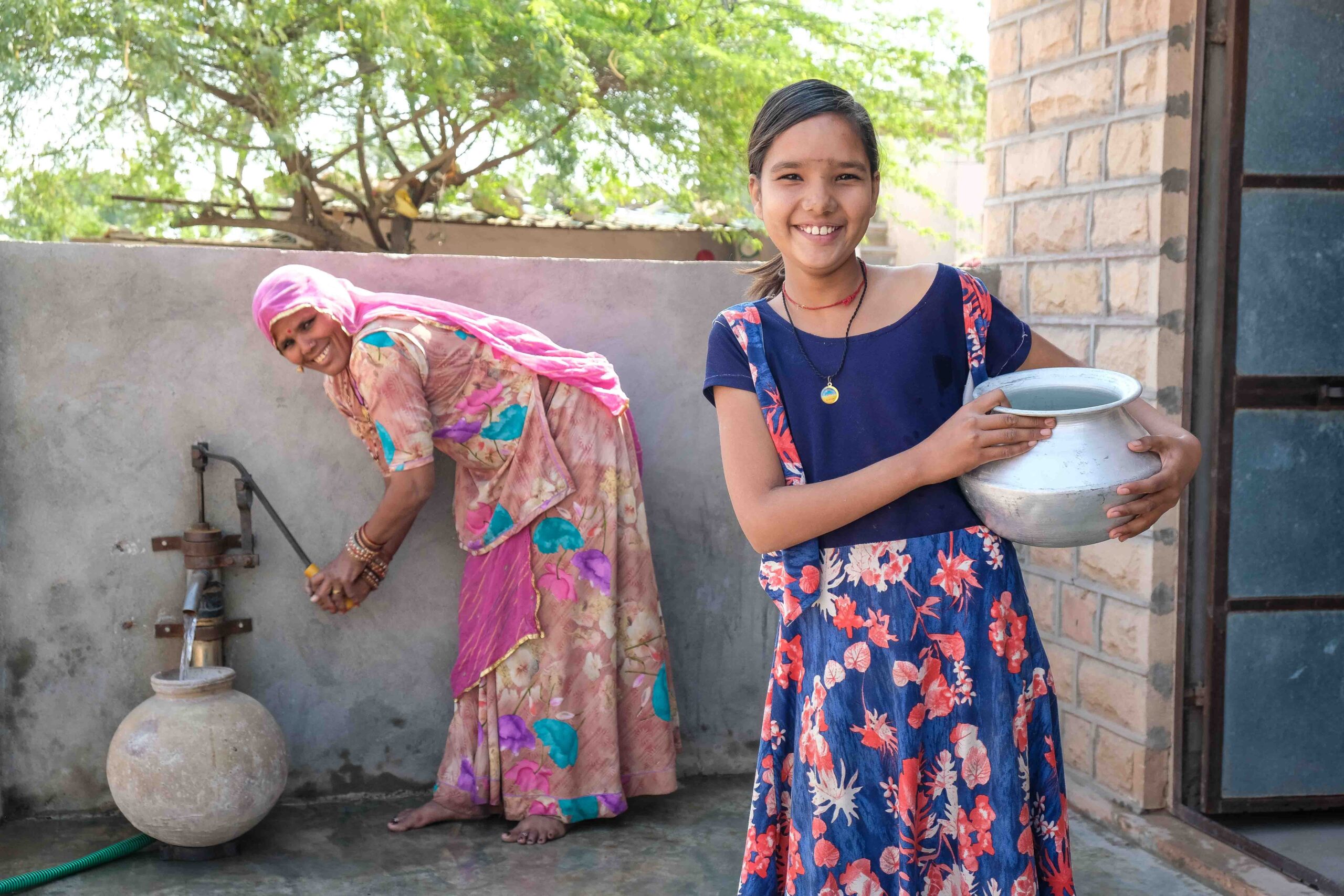
    Fetching water is a major household chore for women in rural India, with some areas seeing them spend up to four hours daily carrying water from sources several kilometres away to meet a family’s needs.

  • Ambuja Cement Foundation ties up with SLB to implement women & water program in Barmer

    Ambuja Cement Foundation ties up with SLB to implement women & water program in Barmer

    The joint project will cover 5 villages of the Gudamalini block of Barmer, reaching over 7200 beneficiaries and 2300 households.

    Ambuja Cement Foundation (ACF) has partnered with SLB Limited to implement Community Development Programs in the Barmer district of Rajasthan.

    Under this partnership ACF aims to empower women through Self-Help Group (SHG) formation, reach out to adolescent girls and focus on bringing water tohousehold doorsteps by encouraging building rooftop rainwater harvesting systems.

    The joint project will cover 5 villages of the Gudamalini block of Barmer, reaching over 7200 beneficiaries and 2300 households, ACF said in a statement.

    Under the Women Empowerment initiative, ACF will focus on capacity building of women who belong to socially and economically weaker sections of the society.

    The area in the desert state is a typical rural setting where females are restricted to household chores,have no say in family decision making and are primarily housebound. These women have no access to higher education and are financially dependent on male members of their families. They are even victims of dowry and domestic violence.

    Due to these issues SLB’s CSR Lead, Shreya Sudhir and ACF’s Senior Management have decided to come together to mobilisethese rural women,organise them into groups, and support them in becoming self-reliant.

    Talking about the new partnership, Ambuja Cement Foundation CEO Pearl Tiwari said, “We not only aim to empower women, but build their confidence to overcome the many varied social problems they face. The partnership helps us take a step forward towards our vision of rural prosperity and we look forward to empowering these women to become agents of change in their families and communities.”

    The joint program intends to strengthen the existing 42 SHGs by conducting training program and exposure visits, along with initiatingincome generation activities. ACF will also introduce social security schemes, and encourage stakeholder meetings and workshops in the villages.

    ACF will form groups of adolescent girls – providing training and awareness on areas like nutrition and health education, life skills, access to public services and child care practices, whilst also conductinghealth check-ups along with counselling and guidance on family welfare. Vocational training will also be provided to rural girls above the age of 16 under the National Skill Development Program.

    To enhance year-round access to water, ACF will encourage households to set up Rooftop Rainwater Harvesting systems to capture rainwater and provide drinking water in their homes. Households will be offered support to build systems with a water storage capacity of 10,000 litres.

    Barmer is an area outside the current functional geography of Ambuja Foundation. However, as a grassroots implementation agency with almost 3 decades of vast experience in remote rural areas, ACF is able to replicate its program models seamlessly. Rajasthan is one of the largest priority states for ACF’s community development work, thus both regional skills and networks will be harnessed to reach out to beneficiaries in Barmer.

  • PepsiCo India & ADI partner for improving water security in Mathura

    PepsiCo India & ADI partner for improving water security in Mathura

    Under the project, seven community rainwater harvesting ponds with a groundwater recharge potential of 214 million litres have already been constructed.

    Global food and beverages major PepsiCo along with the Alternative Development Initiatives (ADI) today launched its Sustainable Water Resource Development and Management (SWRDM) program in Uttar Pradesh.

    The comprehensive water resource development strategy aims at replenishing 100 per cent water used in the manufacturing operations and improving the health of local watersheds that are most at risk.

    Under the project, seven community rainwater harvesting ponds with a groundwater recharge potential of 214 million litres have already been constructed, enabling groundwater recharge in seven neighboring villages, PepsiCo India said in a statement.

    Uttar Pradesh Sugarcane Development and Sugar Industry Minister Laxmi Narayan Chaudhary and PepsiCo India President Ahmed ElSheikh inaugurated one of the seven community rainwater harvesting ponds, located in Puthari, Chatta Tehsil, Mathura.

    Mathura Lok Sabha MP and actress Hema Malini, ADI Managing Director Nardev Chaudhary were also present.

    Speaking on the occasion, the UP Sugar Industry Minister said, “This initiative aligns perfectly with the Uttar Pradesh government’s Mission Amrit Sarovar, which aims to restore and invigorate water bodies in the state. PepsiCo India’s actions exemplify how corporate responsibility can be effectively harnessed for the greater public welfare.”

    PepsiCo India President said, “PepsiCo India is excited to partner with Alternative Development Initiatives (ADI) to bring our Sustainable Water Resource Development and Management (SWRDM) strategy to Uttar Pradesh. We endeavor to be partners in progress and are dedicated to replenishing water in local watersheds and continue to raise awareness through community trainings and sustainable practices.”

    ADI Managing Director Rajinder Nijjar said: “In partnership with PepsiCo India, we initiated a comprehensive study of all the villages under Chatta Tehsil to understand the concern of the area and accordingly plan a long-term sustainable water resource development & management strategy.”

    The joint efforts towards these interventions would improve the water quality, groundwater scenario and enhance capacities of the communities for creation of livelihoods in the area, he said.

    As part of this initiative, PepsiCo India and ADI have also been conducting training programs for over 450 farmers with the help of various training institutions and in house capacity building facilities. The training focuses on the need of water conservation and management, modern farming and modern technology awareness, and several other agronomic practices.

    The project includes convergence with government programs and banks for holistic development including formation and empowerment of SHGs across the project area with over 40 members undertaking trainings including soap making, stitching and candle making.

  • Former President Ram Nath Kovind inaugurates Dhanuka Group’s school

    Former President Ram Nath Kovind inaugurates Dhanuka Group’s school

    The higher secondary school, which will provide classes from nursery to 11th, has a capacity to accomodate up to 1000 students.

    Former President Ram Nath Kovind today inauguraged a school constructed by agrochemical makeer Dhanuka Group here at Salasar town — that houses the famous Balaji temple — in Churu district of Rajasthan.

    Shrimati Triveni Devi Dhanuka Higher Secondary Adarsh Vidya Mandir has been built by Dhanuka Group as a part of its corporate social responsibility (CSR) initiatives.

    The higher secondary school, which will provide classes from nursery to 11th, has a capacity to accommodate students up to 1000. Currently, 580 students (320 boy and 260 girl students) are enrolled.

    Constructed over 7586 square meter of land, the school has a staff strength of 37, with 27 of them being teaching staff. It has a facility of air conditioned computer lab with 20 computers and a conference cum hall with multimedia facility.

    Addressing the gathering, Kovind said: “Education has an invaluable contribution in our life and better resources are necessary for this. If the ‘temple of education’ starts in small cities and villages, then it would help in shaping the future of children, their families, society and the country.”

    The inauguration of Adarsh Vidya Mandir by Chiranjilal Dhanuka Charitable Trust in Salasar Dham will make not only make children efficient but a good human being also, he said.

    Union Minister of State for Agriculture and Farmers Welfare Kailash Chowdhary said establishment of this school is a matter of pride in Salasar Dham. “The Dhanuka family has given a temple of education here, which will shape the future of our India,” he said.

    On the occasion, Dhanuka Group Chairman R G Aggarwal said Salasar Dham is renowned for its famous Lord Balaji temple. It is a place where faith is reinforced, and prayers are offered for the fulfilment of wishes.

     “Adarsh Vidya Mandir, inspired by the principles of Vidya Bharti, aims to create a holistic educational experience that instills a deep sense of patriotism, love for Indian cultural heritage, and clear goals. It endeavors to foster balanced spiritual development, molding the future intelligentsia of our great nation and preparing them to contribute meaningfully to its growth,” he added.

    The group has two more schools in same district. One school named Durgaprasad Dhanuka Kanya Adarsh Vidyalaya Mandir is located in neighboring Ratangarh town of same district. This all-girl school has a capacity for 700 students, with 614 girl students benefiting from charitable education. It has a staff strength of 33 personnel, with 29 of them being teachers.

    Located at Hrishikul road in same Ratagarh town of district Churu, the third school ‘Chiranjilal Dhanuka Uchha Madhyamik Adarsh Vidya Mandir has 811 students (all boys) studying from nursery to 12th class. This school has a capacity to accomodate up to 1000 students at a time.

     Besides these charitable schools, Dhanuka Group has been at the forefront of philanthropic activities in other areas of ecology, environment and humanity too.

  • Corporates celebrate World Environment Day

    Corporates celebrate World Environment Day

    Corporates like CNH Industrial and JK Tyre and Industries celebrate the 50th World Environment Day.

    JK Tyre & Industries

    According to JK Tyre & Industries Manufacturing Director Anil K Makkar, the company has been constantly instilling proactive steps towards a greener and sustainable future.

    “In our progressive journey, sustainability is at the centre-stage. In the next five years, we hope to increase the percentage of power usage at our manufacturing facilities from 53% to 75% through renewable sources,”

    By 2050, the company aims to become a carbon-neutral company by integrating innovative technologies and sustainable practices.

    “While we at JK tyre are already a global benchmark on specific raw water consumption, our efforts to attain newer milestones will continue to save this precious drop of life and our environment,” Makkar said in a statement.

    CNH Industrial

    Narinder Mittal, Country Manager and Managing Director – Agriculture Business, CNH Industrial India & SAARC said the company is dedicated to breaking new ground in both innovation and environmental responsibility.

    “From advanced agricultural machinery that promotes precision farming and reduces resource consumption, to our electric and hybrid machines that are redefining the construction industry, we are proud to play an active role in reducing emissions and conserving natural resources,” he said.

      Through ongoing efforts in India, including reducing carbon emissions through solar energy in our plants, supporting water conservation initiatives in nearby villages, preventing stubble burning through our crop residue management in more than 10 locations, and implementing the Miyawaki forest project with a plantation of over 10000 trees, the company is working towards a greener and more sustainable future, he said.

    “This World Environment Day, we reaffirm our dedication to further adapt to sustainable practices” he added.

    Pakka Ltd

    Jagdeep Hira, Business Head of Pakka Ltd said: “In our product development process, we ensure that we minimise waste generation. We’re steadily moving towards the goal of net zero carbon emission, aligned with UN Sustainable Development Goals.”

  • PepsiCo Foundation organizes tree plantation drive in Mathura

    PepsiCo Foundation organizes tree plantation drive in Mathura

    During the program, poster-making competition and flower-pot painting was conducted along with a rally to educate the villagers on the changing effects of the environment.

    On the occasion of World Environment Day, Pandit Jagat Ram Memorial Force Trust and PepsiCo Foundation organized a tree plantation drive in Sacholi village of Nandgaon block in Mathura district, Uttar Pradesh.

    “It is everyone’s responsibility to save the environment and driving public awareness is the most effective way to bring this much-needed change,” said UP cabinet minister Nardev Chaudhary said on the occasion.

    The villagers of the countryside must make a valuable contribution in planting trees and stop cutting down the trees to ensure that our earth is green and full of trees, he said and added planting trees is the most necessary action one can take to make the vision of green earth a reality.

    PepsiCo India, Chief Government Affairs and Communications Officer Garima Singh said: “We encourage communities to join hands and make the sustainable protection of our environment a top priority, enabling us to achieve this goal.”

     Also present at the event, Rajkumar Pathak, Range Officer, Forest Department, urged citizens to take a pledge to plant trees every year and Vijay Kumar Agarwal, BDO of Nandgaon Block, educated the attendees on the importance of saving the environment, driving awareness among communities on protecting trees and plants.

     During the program, poster-making competition and flower-pot painting was conducted along with a rally to educate the villagers on the changing effects of the environment. Workers from Pandit Jagat Ram Memorial Force Trust also contributed to the various activities held on-ground to celebrate World Environment Day.

  • Apollo Hospitals Foundation to plant 90,000 trees in Andhra Pradesh

    Apollo Hospitals Foundation to plant 90,000 trees in Andhra Pradesh

    The trees are being planted across Aragonda village and will offset a carbon footprint of 3,800 tonne. Each sapling is geo-tagged to track maintenance and growth.

    The Apollo Hospitals Foundation has decided to plant 90,000 trees in Aragonda village in Chittoor district, Andhra Pradesh in partnership with the state’s forest department in order reduce carbon emissions, preserve wildlife habitats, and improve air quality for local communities.

      “This initiative is a step towards mitigating the impact of climate change and ensuring a sustainable future,” Apollo Hospitals Group Chairman Dr Prathap C Reddy said in a statement.

      The tree planting initiative was taken as part of Apollo Hospitals Group Chairman’s 90th birthday celebration, said Upasana Kamineni Konidela, Vice Chairperson of Apollo Hospitals’ CSR.

      The state forest department will provide saplings native to the region, and the Apollo Foundation will manage plantation and maintenance.

      The plantation drive will use Miyawaki forest models to bring back native trees of the region and monitor survival rates through geo-tagging of each plant.

      According to the Foundation, the 90,000 trees are being planted across Aragonda to offset the Apollo Hospitals Groups Carbon footprint by 3800 tonne.

      This project aligns with Apollo Foundations’ long-standing commitment to environmental sustainability. The company remains dedicated to reducing its carbon footprint and promoting a greener future for a healthier tomorrow.