Tag: ClimateAction

  • Hyundai plants landmark 1 million trees in IONIQ Forest

    Hyundai plants landmark 1 million trees in IONIQ Forest

    Hyundai Motor India Foundation (HMIF), the corporate social responsibility arm of Hyundai Motor India Limited, has completed the landmark plantation of 1 million trees under its IONIQ Forest initiative near Talegaon in Pune district.

    The project covers 90.5 acres and incorporates 41 native species using the Miyawaki afforestation method, making it one of India’s most significant single-site, time-bound efforts.

    Work began with site clearance in May 2025, followed by initial planting on World Environment Day in June. The forest was officially inaugurated in September 2025 by Maharashtra Chief Minister Devendra Fadnavis.

    Each tree is geo-tagged with a QR code for transparency and real-time monitoring.

    “Hyundai Motor India Foundation’s IONIQ Forest project is more than an afforestation effort; it represents a vision to create a greener and more sustainable future,” said Puneet Anand, AVP and Vertical Head – Corporate Affairs at HMIL.

    “By combining environmental restoration with community empowerment, Hyundai is setting a benchmark for sustainable growth in India,” he said in a statement.

    The initiative has created livelihoods for over 150 members of local tribal communities. Over five years, the forest is expected to sequester 63,000 tons of CO2, boost biodiversity and enhance climate resilience.

    It will also serve as an educational hub for schools and communities to promote environmental awareness.

    The effort aligns with HMIF’s Rs 56 crore CSR commitment in Maharashtra, spanning environment, healthcare, road safety and community development.

  • Zerodha CSR grant boosts SusMafia climate ecosystem

    Zerodha CSR grant boosts SusMafia climate ecosystem

    Brokerage firm Zerodha has awarded a Rs 2 crore CSR grant crore CSR grant to The Sustainability Mafia (SusMafia), a non-profit focused on climate education and early-stage incubation, to boost India’s climate-tech ecosystem.

    The Zerodha CSR grant will enable SusMafia, legally known as The Sustainability Engine Foundation, to expand programs building a skilled climate workforce and supporting startups in sectors like air quality, water sanitation, waste management, carbon reduction, and the circular economy.

    SusMafia addresses gaps in talent readiness, early validation for founders, and connections to capital and pilots.

    Over recent years, the organization has trained over 400 climate professionals via its Climate Ninja program and deployed Rs 1 crore in grants to ventures, fostering a network of more than 80 climate entrepreneurs.

    With the new funding, SusMafia plans to train over 300 additional Climate Ninjas, support more than 20 early-stage startups, and host events like SusCrunch for stakeholder collaboration.

    “Strong climate outcomes emerge when founders, practitioners, and learners have access to the right knowledge and support early in their journey,” said Nithin Kamath, CEO of Zerodha. “SusMafia is building this connective tissue, and we’re pleased to back their work.”

    Ganesh Shankar, Director of SusMafia, added: “This Zerodha CSR grant strengthens our ability to build community, bringing founders, talent, and partners closer to make sustainability the default choice.”

    Zerodha, through its Rain Matter initiative, supports long-term climate and sustainability efforts across India.

    SusMafia collaborates with institutions including the Indian School of Business (ISB), IIT Madras, and Ashoka University, and networks with startups like PadCare, Dexler Energy, and Lucro.

  • ACC’s transforming water conservation in Dhakori village in Maharashtra

    ACC’s transforming water conservation in Dhakori village in Maharashtra

    ACC, part of the Adani Portfolio, and the Adani Foundation are advancing climate resilience through transforming water conservation efforts in rural Maharashtra.

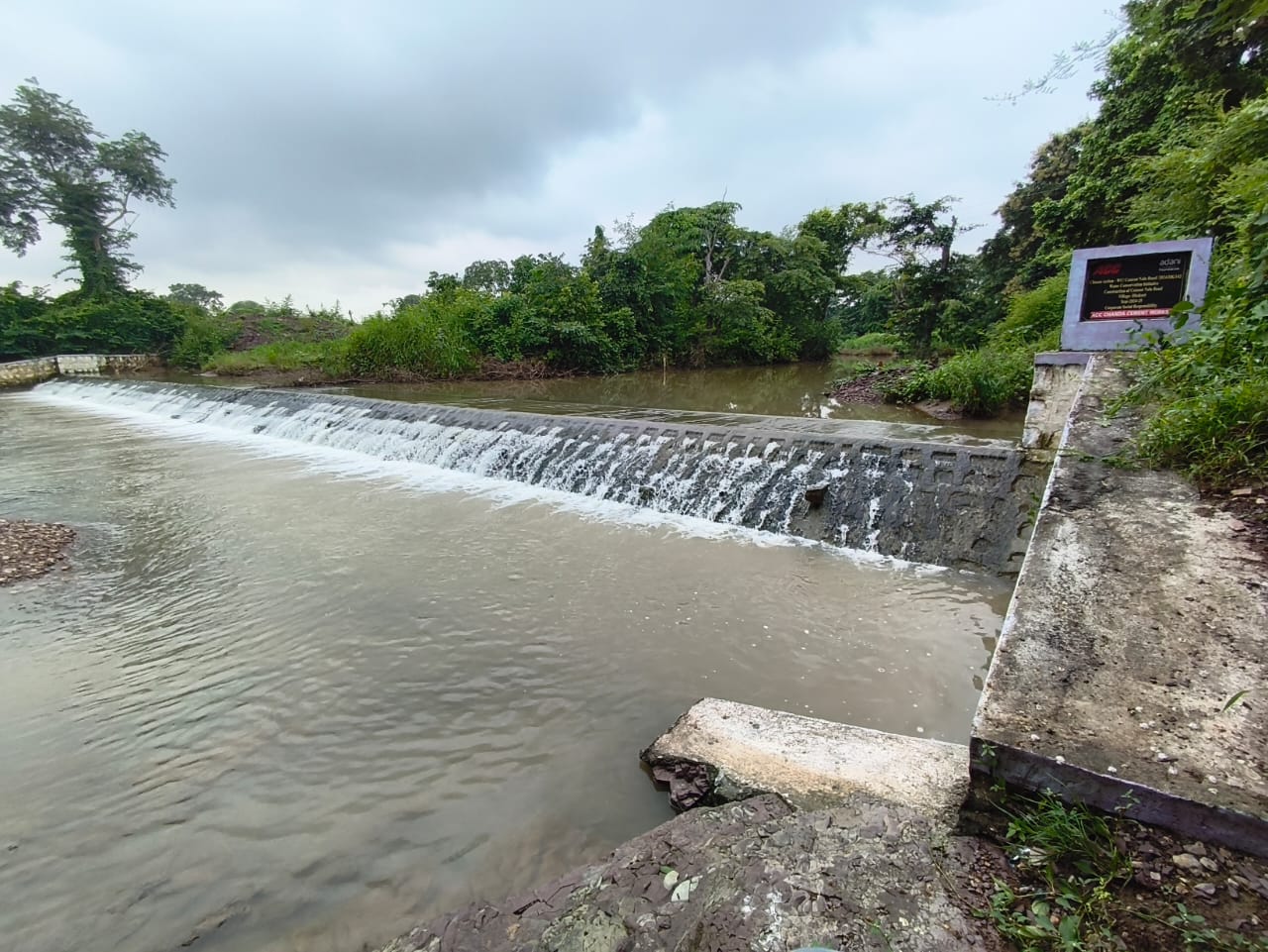
    In Dhakori village, Wani block, Yavatmal district, the companies addressed chronic water scarcity by building an upstream cement nala bund under the 2024-25 Climate Action Water Conservation initiative.

    Despite heavy monsoons, runoff previously left fields dry by November, restricting farmers to one crop annually.

    The new structure stores nearly 48,000 litres of water, recharges borewells and provides year-round supply to 96 acres of farmland.

    Around 35 farmers now grow multiple crops, with incomes rising by about Rs 18,000 per acre.

    The project has also secured household and livestock water supplies, fostering community stability.

    By revitalising resources in Dhakori, ACC and the Adani Foundation demonstrate how targeted, community-led initiatives can achieve sustainable rural development amid climate challenges.

    For more on ACC’s initiatives, visit ACC Limited. Details on Adani Foundation’s work available at Adani Foundation.

  • Empowering SUTRA 2025 Sustainable Trade Summit: India’s resilient future

    Empowering SUTRA 2025 Sustainable Trade Summit: India’s resilient future

    India is committed to advancing circularity and strengthening farm-to-factory linkages to position its textiles as a global model of responsibility and resilience, a senior Ministry of Textiles official said on Thursday.

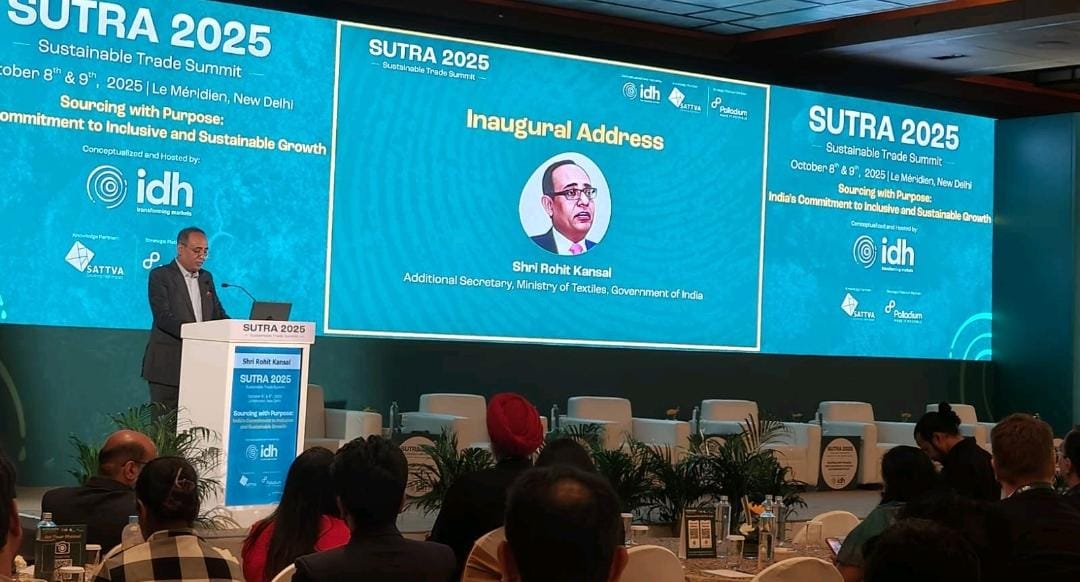
    “With the right partnerships, investments, and innovations, we can weave a future that is not only equitable and climate-resilient but also defines India’s leadership in sustainable growth,” Rohit Kansal, Additional Secretary in the Ministry of Textiles, said at the SUTRA 2025 sustainable trade summit in New Delhi.

    Kansal said the IDH SUTRA 2025 platform brings together farmers, farmer producer organizations (FPOs), financiers, innovators, and industry stakeholders, embodying the meaning of SUTRA—the thread that connects them all.

    “Collaboration is the cornerstone of transformation, and through initiatives like this, India is demonstrating how sustainability can move from compliance to competitiveness, from intent to impact,” he added.

    The SUTRA 2025 sustainable trade summit brought together over 400 delegates and 35 speakers from government, industry, development institutions, academia, and farmer organizations to explore how purpose-led sourcing can accelerate India’s transition to climate-resilient and socially equitable trade systems.

    The summit highlighted India’s growing leadership in embedding sustainability and inclusion into its trade and agricultural systems.

    This year’s edition featured a Sustainability Experience Centre showcasing innovations in traceability, regenerative farming, and circular production. Interactive demonstrations and solution pitches enabled participants to explore how emerging technologies and data-driven systems can enhance transparency and accountability across supply chains, aligning with principles of responsible sourcing.

    Industry leaders including Sougata Niyogi of Godrej Agrovet, Sudhakar Desai of Emami Agrotech and IVPA, and executives from SAP, ITC Limited, Hindustan Unilever, and ICRIER shared perspectives on aligning business competitiveness with climate action and social responsibility. These empowering discussions at the SUTRA 2025 sustainable trade summit underscored the potential for scalable, inclusive solutions in sustainable trade.

  • India’s Green Giants: Wipro, Tech Mahindra Lead Global Sustainability Charge

    India’s Green Giants: Wipro, Tech Mahindra Lead Global Sustainability Charge

    By Eldee

    When TIME Magazine and Statista rolled out their 2025 World’s Most Sustainable Companies list in June, two Indian IT powerhouses stole the spotlight. Bengaluru’s Wipro (53rd, score: 75.83) and Pune’s Tech Mahindra (57th, 75.13) didn’t just make the global top 100—they were India’s sole representatives there.

    But the story’s bigger: eight other Indian firms, from Mahindra (201st, 66.77) in automotive to Dr. Reddy’s (417th, 59.36) in pharma, also cracked the 500-strong list, signaling India’s rising clout in the global green race.

    As climate alarms blare—from Delhi’s choking smog to Kerala’s relentless floods—this isn’t just a feather in India’s cap; it’s a rallying cry for Corporate India to power our 2047 Viksit Bharat vision of a developed, sustainable nation.

    For years, India’s IT sector was written off as the world’s code mill, churning out software for Western giants. Wipro and Tech Mahindra are torching that stereotype. Wipro’s Lab45 AI platform slashed water use by 40% for US farmers in 2023 with smart irrigation—vital tech for a nation where 600 million battle water scarcity. “Sustainability drives our innovation,” CEO Thierry Delaporte told TIME.

    In 2025, Wipro’s FullStride Cloud tie-up with Pure Storage is supercharging clients’ green transitions, dovetailing with Budget 2025’s push for AI-driven clean tech. Tech Mahindra’s EcoForge platform, meanwhile, helped telecom majors like Vodafone cut emissions by 35% by linking data centres to renewables, while their 1-million-mangrove drive in Maharashtra shields coasts from erosion. “We’re redefining tech for a sustainable future,” CEO Mohit Joshi said, a vision reinforced by their 2025 Terra Carta Seal. These aren’t just firms; they’re India’s green vanguards.

    The list’s ten Indian stars—Mahindra, Airtel (223rd, 65.87), HCLTech (233rd, 65.51), WNS (290th, 63.37), Hindustan Zinc (313th, 62.49), Syngene International (364th, 61.08), Infosys (374th, 60.84), TCS (383rd, 60.65), Godrej Properties (413th, 59.54), and Dr. Reddy’s—show India’s green push spans sectors.

    Mahindra’s electric vehicles, Airtel’s renewable-powered towers, and Dr. Reddy’s eco-conscious drugs prove we’re not just followers but pacesetters. India’s 99th rank on the 2025 SDG Index—our first top-100 finish—rides on 42% renewable energy (we’re the world’s third-largest producer) and a tech market zooming to $60 billion, per Nasscom, with 126,000 new AI and ESG jobs in 2025. But the road’s bumpy: data centres guzzle power, supply chains stay opaque, and EY warns we’ve met just 25% of green investment needs. With net-zero by 2070 in focus and Budget 2025 boosting solar and battery storage, Corporate India must shift gears fast.

    While Schneider Electric (France, 93.85), Telefónica (Spain, 87.68), Brambles (Australia, 86.14), Temenos (Switzerland, 85.95), and Moncler (Italy, 85.87) top the list with European flair, India’s ten-strong contingent, led by Wipro and Tech Mahindra, shows we can hold our own.

    Global trade hiccups like tariffs may sting, but they underline India’s edge: affordable, scalable green tech that the Global South hungers for.

    For 1.4 billion Indians, sustainability isn’t a buzzword—it’s do-or-die. Wipro and Tech Mahindra have cracked the code; now Mahindra’s EVs, TCS’s low-carbon IT, and others must follow. The world’s watching, and India’s ready to lead—not just on rankings, but in scripting a greener future.