Tag: ESG

  • ICSI unveils Stewardship Principles after COP30

    ICSI unveils Stewardship Principles after COP30

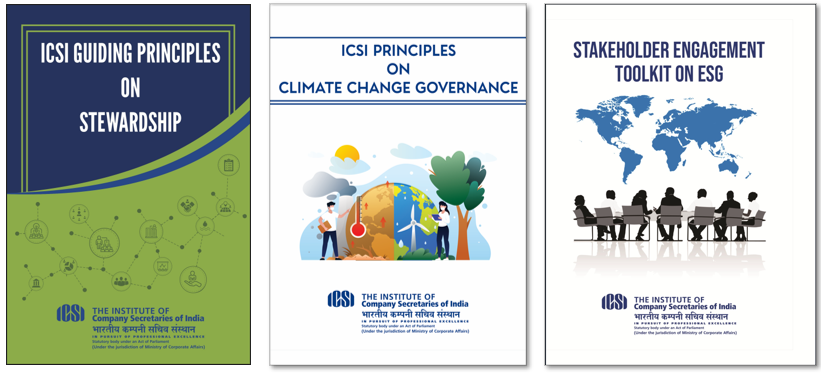
    Institute of Company Secretaries (ICSI) has launched guiding principles on stewardship to embed environmental, social and governance (ESG) practices in corporate strategies, building on commitments from the COP30 climate summit in Brazil.

    The ICSI Guiding Principles on Stewardship (IGPS) promote responsible asset management for long-term value, with adoption mandated by the International Financial Services Centres Authority (IFSCA) for fund managers and institutional investors in India’s financial hubs. The principles shift focus from short-term gains to sustainable growth, urging stewards to demand robust ESG frameworks.

    Complementing the IGPS, ICSI released a Stakeholder Engagement Toolkit on ESG this year to help company secretaries and boards craft comprehensive policies. It also introduced the ICSI Principles on Climate Change Governance (IPCG), offering metrics and targets for transparent climate disclosures.

    “Integrating climate considerations into business requires well-crafted principles, detailed guidance and equipped professionals,” ICSI President CS Dhananjay Shukla said. “As a leader in best practices, ICSI delivers through these initiatives.”

    ICSI Secretary CS Asish Mohan added: “In a climate-challenged world, we leverage investors and stewards for principles-based governance supporting sustainable development.”

    The moves align with global pushes for climate finance and multilateral action, as nations at COP30 pledged new tools to combat warming.

  • Global CSR best practices for Indian firms to adopt now

    Global CSR best practices for Indian firms to adopt now

    By Eldee

    Indian Corporate Social Responsibility (CSR) stands at a crossroads. While mandatory spending under Section 135 of the Companies Act has mobilized over Rs 15,500 crore annually, the decline to 1.87% of net profit—a six-year low—signals that compliance isn’t enough. The answer lies abroad: global best practices that transform CSR from obligation to competitive advantage.

    As Indian firms eye international markets and global talent, adopting world-class CSR strategies isn’t optional—it’s imperative. Here’s the blueprint that’s revolutionizing corporate citizenship worldwide.

    Strategic Alignment: Making CSR Core, Not Peripheral

    The first global CSR best practice Indian firms must embrace: integrate CSR with core business strategy, not treat it as a separate charitable wing.

    Technology giants like Microsoft don’t just donate computers—they build digital literacy programs that create future customers and skilled workers. Pharmaceutical companies like Novartis don’t simply fund clinics—they develop healthcare infrastructure that strengthens entire supply chain ecosystems.

    Indian companies can mirror this approach. Technology firms should champion digital literacy initiatives, healthcare companies prioritize public health systems, manufacturing units drive circular economy models. When Tata’s multi-year village development programs align industrial growth with community prosperity, they exemplify this integration—creating shared value, not one-way charity.

    Long-Term Impact Over Short-Term Optics

    Global leaders have abandoned the photo-opportunity approach. Instead of ribbon-cutting ceremonies, they commit to multi-year programs with measurable, lasting outcomes.

    Indian firms currently average project durations under 18 months. International best practice demands 3-5 year commitments minimum—time horizons that allow education programs to graduate students, healthcare initiatives to reduce disease burden, environmental projects to restore ecosystems.

    Unilever’s Sustainable Living Plan spans decades. Patagonia’s environmental commitments are generational. Indian corporations must shift from annual CSR budgets to sustained campaigns that compound impact over time, particularly in education, environmental restoration, and economic empowerment.

    Stakeholder Co-Creation: Community as Partner, Not Recipient

    Perhaps the most critical global best practice: genuine stakeholder engagement throughout the CSR lifecycle.

    Leading international corporations involve local communities, employees, customers, NGOs, and government bodies from initial design through implementation and evaluation. Communities aren’t beneficiaries—they’re co-creators.

    Indian CSR often suffers from top-down imposition: urban corporate offices deciding rural priorities without consultation. Global best practice demands listening tours, community needs assessments, participatory design workshops, and local advisory boards. When stakeholders shape programs, success rates multiply—needs are accurately addressed, cultural contexts respected, sustainability ensured.

    Collaboration Ecosystems: Leverage Expert Networks

    No corporation possesses all expertise needed for complex social challenges. Global leaders build collaboration ecosystems.

    They partner with specialized NGOs for on-ground execution, academic institutions for research and evaluation, government agencies for scale and policy alignment, other corporations for collective impact initiatives.

    Indian firms can dramatically enhance CSR effectiveness through strategic partnerships. Rather than building parallel systems, leverage existing NGO networks with decades of community relationships. Rather than proprietary programs, join industry coalitions addressing systemic issues—child nutrition, water conservation, skill development—where collective action produces exponential results.

    Innovation and Digital Integration: Technology as Force Multiplier

    Global CSR increasingly deploys cutting-edge technology for reach, efficiency, and impact measurement.

    Digital platforms extend education to remote villages through mobile learning. Telemedicine connects rural patients with specialist doctors. Blockchain ensures transparent fund tracking. AI analyzes program data to optimize interventions in real-time. IoT sensors monitor environmental restoration projects continuously.

    Indian firms, particularly in technology sectors, must leverage innovation for social good. The Ministry’s new web-based CSR-1 registration system effective July 2025 signals this direction—demanding digital tracking, transparent reporting, real-time monitoring. Companies should exceed these requirements, building sophisticated impact measurement systems that demonstrate return on social investment.

    ESG Integration: From CSR to Holistic Sustainability

    The global frontier: integrating Environmental, Social, and Governance (ESG) frameworks that encompass but transcend traditional CSR.

    International leaders adopt Science Based Targets initiative (SBTi) for climate commitments, join RE100 for renewable energy transition, pursue EV100 for electric vehicle fleets. They establish dedicated ESG committees at board level, integrate sustainability into executive compensation, publish comprehensive sustainability reports aligned with Global Reporting Initiative (GRI) standards.

    Indian firms must recognize ESG as business imperative, not compliance burden. Climate action reduces operational risks. Supply chain sustainability ensures resilience. Diversity and inclusion attract global talent. Robust governance mechanisms build investor confidence.

    Maharashtra, Gujarat, Uttar Pradesh, Rajasthan, Karnataka, and Tamil Nadu currently dominate CSR fund receipt—but ESG integration demands geographic equity, ensuring underserved regions receive proportionate investment.

    Transparency and Rigorous Impact Measurement

    Global best practice demands obsessive transparency and data-driven impact assessment.

    Leading corporations publish detailed CSR reports with specific metrics: students educated, patients treated, carbon sequestered, women entrepreneurs trained. They conduct third-party evaluations, randomized controlled trials, longitudinal studies measuring sustained impact years after program completion.

    Indian companies must move beyond anecdotal success stories and input metrics (money spent, events conducted) to outcome metrics (lives improved, behaviors changed, systems strengthened). Rigorous documentation, digital tracking, independent audits, and public disclosure build credibility and enable continuous improvement.

    Governance Architecture: Institutional Commitment

    Global leaders establish robust governance structures ensuring CSR isn’t dependent on individual champions but embedded institutionally.

    Board-level CSR/ESG committees provide strategic oversight. Chief Sustainability Officers hold executive authority. Cross-functional teams integrate social impact across business units. Employee volunteer programs democratize participation. Supplier codes mandate responsible practices throughout value chains.

    Indian firms should elevate CSR from compliance function to strategic capability, with dedicated leadership, adequate resourcing, and clear accountability mechanisms that survive leadership transitions and market fluctuations.

    The Competitive Advantage

    Why should Indian firms urgently adopt these global best practices? Because CSR excellence drives competitive advantage in increasingly conscious markets.

    Consumers prefer purpose-driven brands. Investors demand ESG performance. Employees choose companies with authentic social commitments. Communities welcome businesses that contribute meaningfully. Governments partner with corporations demonstrating responsibility.

    As India aspires toward developed nation status, Corporate Social Responsibility must evolve from defensive compliance to offensive strategy—where social impact and business success reinforce each other, where doing good and doing well become indistinguishable.

    The Rs 15,524 crore currently deployed annually represents immense potential. Channeled through global best practices—strategic alignment, long-term commitment, stakeholder engagement, collaborative ecosystems, technological innovation, ESG integration, rigorous measurement, and institutional governance—Indian CSR can transform from regulatory obligation to national competitive advantage.

    The global playbook exists. The question isn’t whether Indian firms can adopt these practices. It’s whether they can afford not to.
  • Coffee Board Seeks Feedback on Sustainability Scheme to Boost Recognition for Indian Producers

    Coffee Board Seeks Feedback on Sustainability Scheme to Boost Recognition for Indian Producers

    The Coffee Board has invited public consultation on its draft sustainability certification framework, aiming to address a critical gap in recognition for India’s coffee sector despite the country’s adherence to sustainable practices across over 400,000 small and marginal holdings.

    The Indian Coffee Board Sustainability Certification Scheme (INDICOFS), developed by a Core Technical Committee comprising domain experts, introduces a voluntary three-tier compliance system designed to progressively align Indian coffee producers with international sustainability standards.

    Bridging the Recognition Gap

    The sector is integral to the livelihoods of approximately two million individuals, with farms situated in high biodiversity regions, notably the Western and Eastern Ghats. These regions provide essential ecosystem services and are home to numerous major rivers, underscoring the critical role that coffee cultivation plays in environmental stewardship.

    Despite adherence to sustainable agricultural practices integrating social, economic and environmental dimensions, the Indian coffee industry has not achieved recognition commensurate with its quality and production methods. While global demand for sustainably certified coffee has increased, only approximately 15% of India’s total coffee output is currently certified under sustainable certification criteria.

    INDICOFS Framework

    In response to the need for a coherent sustainability framework, the Coffee Board has developed INDICOFS—a set of sustainability standards tailored to the Indian context. The standards acknowledge best practices implemented by Indian coffee farms and facilitate a structured approach for continual improvement, ensuring sustainability across the coffee value chain.

    The scheme covers two phases. The first phase addresses “Sustainability Standards for Indian Coffee Plantations,” while the second phase focuses on “Chain of Custody Standards.” The framework encompasses sustainability standards, inspection procedures and certification protocols.

    The certification system defines three compliance levels:

    Level 1 (Basic/Self-Assessment): Provides foundational requirements for growers to evaluate practices and identify improvement opportunities, overseen by Coffee Board inspections

    Level 2 (Aspiring/Auditing): Outlines criteria for third-party verification, ensuring compliance and facilitating progression beyond basic practices

    Level 3 (Benchmarked Best Practices): Delineates advanced sustainability benchmarks assessed by recognized auditing bodies, signifying alignment with international standards

    Implementation and Oversight

    Implementation of INDICOFS will be managed by the Central Coffee Research Institute (CCRI), functioning under the administrative control of Coffee Board of India, recognized as one of the oldest public coffee research institutions globally.

    The standards are designed to address the evolving landscape of coffee production, including critical issues related to trade, environmental sustainability and preservation of traditional farming practices. A key innovation is INDICOFS’ holistic integration of responsible production methodologies with practices that enhance climate adaptation and minimize ecological footprints.

    The standard addresses critical Environmental, Social and Governance (ESG) aspects essential for sustainable coffee farming and incorporates general disclosure requirements aimed at providing stakeholders with transparent, relevant and comparable information about production operations.

    Public Consultation Invited

    The Coffee Board has posted the draft INDICOFS scheme along with an overview note on its website for wider consultation. Stakeholders and members of the public are invited to review the documents and share their views, comments and suggestions.

    Comments must be submitted in the prescribed format (Annexure-I) by email to dirresh@gmail.com with a copy to drccri2022@gmail.com on or before October 24, 2025.

    “The Coffee Board values your feedback and cooperation in this important national initiative to position Indian Coffee as a global benchmark for sustainability,” the board stated.

    By adopting this standard, coffee producers can demonstrate compliance with recognized sustainability benchmarks, enhance their marketability and contribute to the global movement toward sustainable agricultural practices. The initiative is expected to foster collaboration among coffee producers and stakeholders to promote a resilient and sustainable Indian coffee industry while improving the long-term viability of coffee farming and quality of life for communities involved in the supply chain.

  • India’s Green Giants: Wipro, Tech Mahindra Lead Global Sustainability Charge

    India’s Green Giants: Wipro, Tech Mahindra Lead Global Sustainability Charge

    By Eldee

    When TIME Magazine and Statista rolled out their 2025 World’s Most Sustainable Companies list in June, two Indian IT powerhouses stole the spotlight. Bengaluru’s Wipro (53rd, score: 75.83) and Pune’s Tech Mahindra (57th, 75.13) didn’t just make the global top 100—they were India’s sole representatives there.

    But the story’s bigger: eight other Indian firms, from Mahindra (201st, 66.77) in automotive to Dr. Reddy’s (417th, 59.36) in pharma, also cracked the 500-strong list, signaling India’s rising clout in the global green race.

    As climate alarms blare—from Delhi’s choking smog to Kerala’s relentless floods—this isn’t just a feather in India’s cap; it’s a rallying cry for Corporate India to power our 2047 Viksit Bharat vision of a developed, sustainable nation.

    For years, India’s IT sector was written off as the world’s code mill, churning out software for Western giants. Wipro and Tech Mahindra are torching that stereotype. Wipro’s Lab45 AI platform slashed water use by 40% for US farmers in 2023 with smart irrigation—vital tech for a nation where 600 million battle water scarcity. “Sustainability drives our innovation,” CEO Thierry Delaporte told TIME.

    In 2025, Wipro’s FullStride Cloud tie-up with Pure Storage is supercharging clients’ green transitions, dovetailing with Budget 2025’s push for AI-driven clean tech. Tech Mahindra’s EcoForge platform, meanwhile, helped telecom majors like Vodafone cut emissions by 35% by linking data centres to renewables, while their 1-million-mangrove drive in Maharashtra shields coasts from erosion. “We’re redefining tech for a sustainable future,” CEO Mohit Joshi said, a vision reinforced by their 2025 Terra Carta Seal. These aren’t just firms; they’re India’s green vanguards.

    The list’s ten Indian stars—Mahindra, Airtel (223rd, 65.87), HCLTech (233rd, 65.51), WNS (290th, 63.37), Hindustan Zinc (313th, 62.49), Syngene International (364th, 61.08), Infosys (374th, 60.84), TCS (383rd, 60.65), Godrej Properties (413th, 59.54), and Dr. Reddy’s—show India’s green push spans sectors.

    Mahindra’s electric vehicles, Airtel’s renewable-powered towers, and Dr. Reddy’s eco-conscious drugs prove we’re not just followers but pacesetters. India’s 99th rank on the 2025 SDG Index—our first top-100 finish—rides on 42% renewable energy (we’re the world’s third-largest producer) and a tech market zooming to $60 billion, per Nasscom, with 126,000 new AI and ESG jobs in 2025. But the road’s bumpy: data centres guzzle power, supply chains stay opaque, and EY warns we’ve met just 25% of green investment needs. With net-zero by 2070 in focus and Budget 2025 boosting solar and battery storage, Corporate India must shift gears fast.

    While Schneider Electric (France, 93.85), Telefónica (Spain, 87.68), Brambles (Australia, 86.14), Temenos (Switzerland, 85.95), and Moncler (Italy, 85.87) top the list with European flair, India’s ten-strong contingent, led by Wipro and Tech Mahindra, shows we can hold our own.

    Global trade hiccups like tariffs may sting, but they underline India’s edge: affordable, scalable green tech that the Global South hungers for.

    For 1.4 billion Indians, sustainability isn’t a buzzword—it’s do-or-die. Wipro and Tech Mahindra have cracked the code; now Mahindra’s EVs, TCS’s low-carbon IT, and others must follow. The world’s watching, and India’s ready to lead—not just on rankings, but in scripting a greener future.