
Tag: #CorporateIndia

  • CSR Social Stock Exchange: India opens 10% investment window for firms

    CSR Social Stock Exchange: India opens 10% investment window for firms

    The corporate affairs ministry has opened a new funding channel for nonprofits, allowing companies to direct up to 10 per cent of their mandatory corporate social responsibility spending into zero coupon zero principal instruments listed on the Social Stock Exchange, in a move aimed at deepening transparency in social sector financing.

    The amendment, effective immediately, inserts the subscription to such instruments into Schedule VII of the Companies Act, 2013 — the schedule that governs permissible CSR activities for profit-making companies required to spend at least 2 per cent of their three-year average net profit annually on social causes.

    Under the revised CSR Policy Rules, 2014, definitions for both not-for-profit organisations and zero coupon zero principal instruments have been formally introduced for the first time, providing regulatory clarity to companies seeking to deploy funds through the Social Stock Exchange.

    Not-for-profit organisations will be able to issue these instruments through the Social Stock Exchange in accordance with regulations set by the Securities and Exchange Board of India, the ministry said in a statement on Friday.

    Unlike conventional bonds, zero coupon zero principal instruments carry no interest payments and no repayment of principal, functioning instead as a regulated grant or social investment vehicle designed to fund public welfare projects.

    “It helps in furtherance of a transparent and credible mode of funding CSR projects by companies and enables social enterprises to access a wider pool of capital,” said Anshul Jain, Partner Regulatory at PwC India.

    The 10 per cent cap on CSR Social Stock Exchange investments per financial year is intended to balance innovation with fiscal discipline, ensuring core CSR commitments remain intact while creating fresh pathways for social capital mobilisation.

    The Social Stock Exchange, established under SEBI oversight, is designed to bring market discipline and disclosure standards to social sector funding — a segment historically dominated by opaque grant-making and bilateral philanthropy.
  • Malabar Gold pledges bold Rs 200 cr CSR push in 2026-27

    Malabar Gold pledges bold Rs 200 cr CSR push in 2026-27

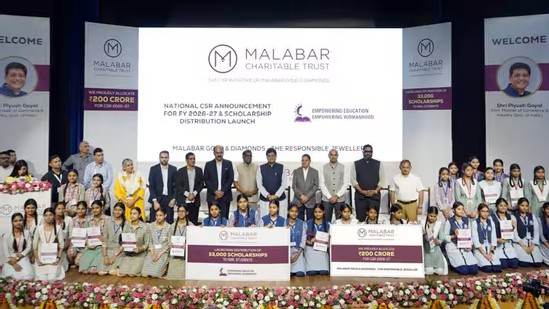
    Malabar Gold & Diamonds has kicked off its most ambitious Corporate Social Responsibility cycle to date, with a bold Rs 200 crore programme for 2026-27 now under way across 19 states.

    The retail jewellery group unveiled the plan earlier this week at the Dr. Ambedkar International Centre in New Delhi, where Union Minister for Commerce and Industry Piyush Goyal inaugurated the distribution of educational scholarships for 33,000 girl students.

    The Malabar Gold CSR 2026-27 initiative spans 15 major programmes at more than 3,000 locations and is designed to benefit over two lakh people by the end of the financial year.

    “Malabar Gold & Diamonds’ decision to allocate INR 200 crore towards CSR will further strengthen the nation’s progress,” Goyal said at the launch event Wednesday. He emphasised that India’s growth is rooted in the empowerment of women and girls.

    Education receives the largest share at Rs 114 crore. Scholarships are now being distributed to students across 284 districts in 18 states — a rollout timed to mark the group’s 33rd anniversary. Micro-learning centres for street children, run in partnership with the Pratham Education Foundation, are also being expanded this year from 1,543 to 2,500 locations across 17 states, with enrolment targets rising from 64,000 to one lakh students.

    Group Chairman M.P. Ahammad said “human resource development is the backbone of national growth,” and added that the scholarship programme gives students the means to contribute to national development. Pratham CEO Rukmini Banerji, who attended the New Delhi launch, called the micro-learning model a proven route to reaching the hardest-to-reach children.

    Food security is the second-largest priority. The Hunger Free World project, allocated Rs 30 crore, already provides daily nutritious meals to 1,15,000 people in India, Zambia, and Ethiopia — a figure the group aims to grow through this cycle. The Grandma Home initiative for destitute mothers anchors the Rs 25 crore housing allocation, while Rs 14.2 crore funds healthcare access, including subsidised medicines through Malabar-Thanal pharmacies.

    Environmental protection receives Rs 10 crore, with the remaining Rs 6.8 crore directed at other humanitarian activities.

    The programmes are administered by the Malabar Charitable Trust, which channels five per cent of the company’s net trading profit into CSR activities annually. The group operates under ESG principles centred on women’s empowerment, healthcare, and education.

    The launch on Wednesday was attended by Malabar Group Managing Director of India Operations Asher Ottamoochikkal, Executive Directors Nishad A.K. and Abdulla Ibrahim, Kerala House Resident Commissioner Puneet Kumar, and Thanal Chairman Idris.