Category: Sustainable World

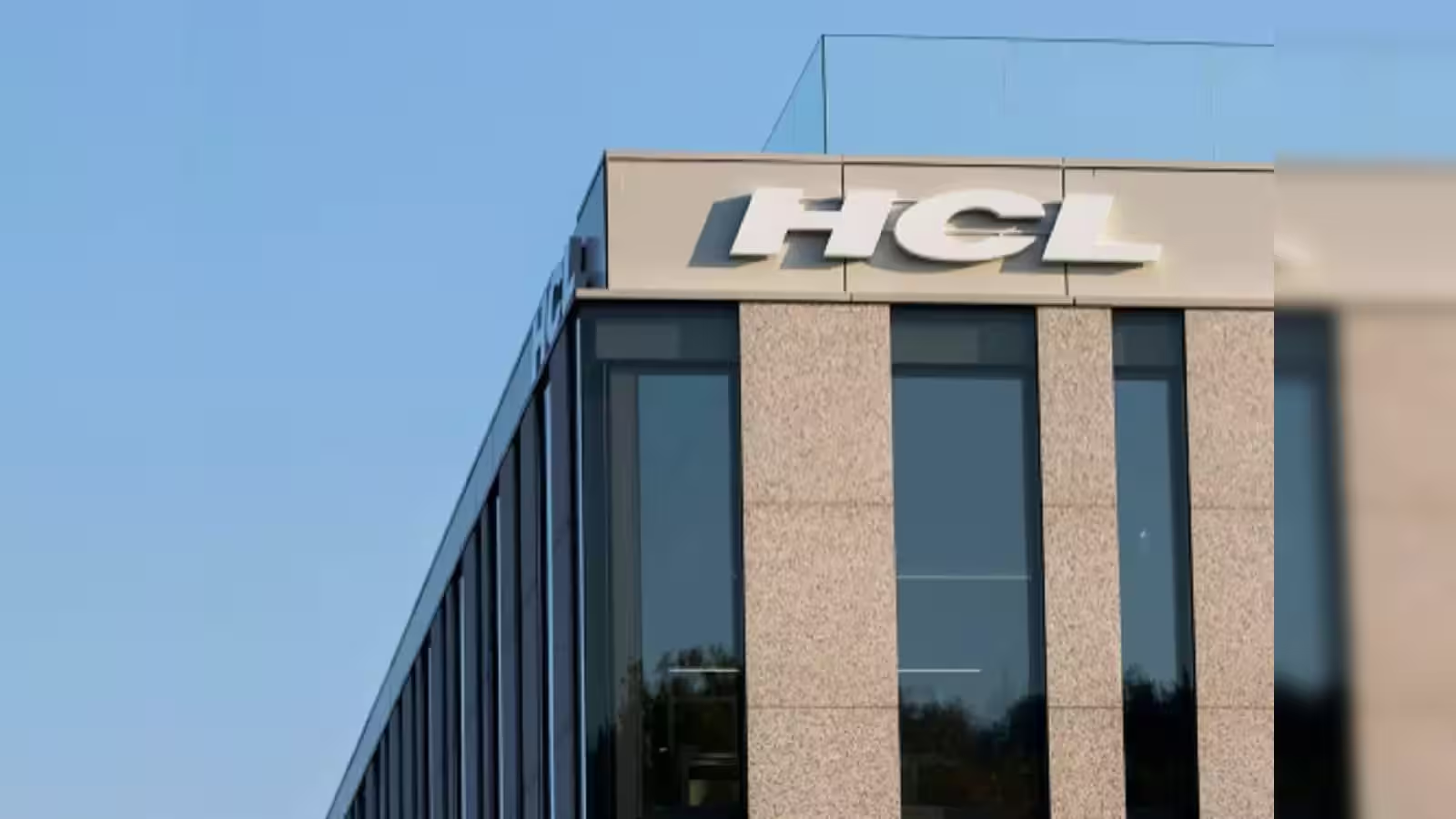
  • HCLTech awards $1 million climate grants in Americas

    HCLTech awards $1 million climate grants in Americas

    HCLTech awards USD 1 million under its HCLTech Climate Grant to three nonprofit organizations in the Americas for innovative climate resilience projects, with Guatemala’s CISP taking the top prize.

    CISP will receive USD 500,000 to enhance water security and sustainable land management in Guatemala’s dry corridor through rainwater harvesting benefiting 200 families, the company said in a statement.

    Runners-up Aves Argentinas (Argentina) and Lluvia para Todos (Mexico) will each get USD 250,000 for biodiversity conservation in the Atlantic Forest and community rainwater systems serving 2,300 people, respectively.

    The third edition of the HCLTech Climate Grant saw applications from 10 countries across the Americas, a 41 percent increase from previous years. A jury of HCLTech leaders and external experts selected the winners based on scalability and local relevance.

    “We are inspired by the ingenuity and commitment demonstrated by this year’s recipients,” said Nidhi Pundhir, Senior Vice President, Global CSR, HCLTech.

    Launched in 2023 with a USD 5 million commitment over five years, the program has so far supported ecological restoration, planted over 360,000 trees and mangroves, and empowered more than 1,400 young people in climate leadership.

  • Standard Chartered launches breakthrough Rs 540 Cr SLTF

    Standard Chartered launches breakthrough Rs 540 Cr SLTF

    Standard Chartered Bank has extended a breakthrough Sustainability-Linked Trade Facility (SLTF) worth Rs 540 crore to Indorama India Private Limited, the bank announced on Wednesday, in a move that deepens its push to embed environmental, social, and governance (ESG) principles into corporate financing across South Asia.

    The facility, structured as a sustainability-linked trade and working capital arrangement, ties its financing terms directly to Indorama India’s achievement of clearly defined Sustainability Performance Targets (SPTs) aligned with the company’s broader ESG framework. The structure is designed to financially incentivise measurable progress on sustainability, rather than treating ESG commitments as aspirational.

    “We are pleased to partner with Indorama India in supporting its sustainability journey through this tailored SLTF,” said Angel Sivan, Regional Head of Transaction Banking Corporate Sales, India and South Asia, Standard Chartered. “By integrating ESG-linked targets into the deal structure, we are enabling our clients to align their growth with more responsible business practices.”

    Manish Kumar Agarwal, Chief Financial Officer of Indorama India, called the deal a reflection of the company’s resolve to mainstream sustainability into its core financing activities. “This strengthens our liquidity position and reinforces our dedication to ESG principles,” he said, adding that the company intends to build on the momentum toward a broader sustainable finance agenda.

    The transaction adds to a growing pipeline of sustainability-linked financing deals in India, as corporates and lenders seek to operationalise ESG commitments through binding financial mechanisms rather than voluntary pledges.

    Standard Chartered, which has maintained a continuous presence in India for over 165 years, operates across Corporate and Investment Banking and Wealth and Retail Banking segments through an extensive branch network covering major cities.
    Globally, the London- and Hong Kong-listed bank operates in 54 markets.

  • TTK Prestige wins CII greenco certification with 70% renewable energy

    TTK Prestige wins CII greenco certification with 70% renewable energy

    TTK Prestige, India’s largest kitchen appliances company, has earned the CII GreenCo Certification across all its manufacturing plants, capping nearly three years of focused sustainability investment that has driven a 51% reduction in CO₂ emissions and lifted renewable energy usage to 70% of total consumption.

    The certification, awarded by the CII–Sohrabji Godrej Green Business Centre under its nationally recognised Green Company Rating System, validates a sustainability journey that began in August 2023.

    It covers the company’s full manufacturing footprint and encompasses energy and carbon management, water conservation, material resource optimisation, green supply chain practices, product stewardship and waste reduction.

    “Sustainability for us is not an initiative — it is a fundamental part of how we design, manufacture, and innovate. Achieving the CII GreenCo Certification is a significant milestone in this journey and a validation of the consistent progress we have made over the past few years,” said Venkatesh Vijayraghavan, MD and CEO, TTK Prestige

    Beyond the headline renewable energy figure, the company reported a 24% reduction in water usage and measurable improvements in material yield across aluminium, stainless steel, plastic, paper and hazardous materials. Specific power consumption has also been reduced, with focused initiatives delivering waste cutbacks across product categories.

    Vijayraghavan said the gains were directly linked to the company’s broader product strategy. “Today, with 70% of our energy coming from renewable sources and a substantial reduction in our carbon footprint, we are building a manufacturing ecosystem that is both efficient and responsible. This enables us to deliver well-designed, superior quality products that are not only innovative and high-performing, but also aligned with environmentally conscious choices.”

    TTK Prestige said the certification reinforces its commitment to green manufacturing practices across its own production facilities, ensuring operations remain aligned with environmentally responsible standards while continuing to deliver consumer products. The company added that its forward focus would be on accelerating momentum and strengthening sustainable practices across operations as it positions itself as a future-ready, responsible brand.

    Part of the TTK Group, TTK Prestige has operated for over six decades and serves millions of Indian households through its Prestige brand, built on the pillars of safety, innovation, durability and trust. The company also owns UK-based Horwood Homewares, acquired in April 2016, and markets the Judge brand in India.

  • Hitachi Vantara cuts client energy use with sustainable data infrastructure

    Hitachi Vantara cuts client energy use with sustainable data infrastructure

    Hitachi Vantara, the data storage and hybrid cloud subsidiary of Hitachi Ltd, published its FY2025 Sustainability Report on Thursday, outlining measurable energy and cost reductions achieved by clients using its latest sustainable data infrastructure platforms, as surging AI workloads reshape the economics of enterprise computing.

    The report arrives as the International Energy Agency warns that global data center electricity consumption could surpass 1,000 terawatt-hours by 2026 — roughly equivalent to a major industrialized nation’s annual usage — driven in large part by artificial intelligence workloads that demand constant, high-performance storage and processing.

    “Sustainability is increasingly tied to operational performance and business outcomes. In FY2025, we focused on helping customers manage the growth of AI and data while improving efficiency and reducing environmental impact,” said Akinobu Shimada, CEO, Hitachi Vantara in a statement.

    Among the report’s most striking findings: Turkish retail bank DestekBank achieved a 25% reduction in data center energy consumption after deploying Hitachi Vantara’s VSP One Block platform, alongside a 35% jump in application performance and a 20% drop in total cost of ownership. Belgian water utility Aquiris, which processes more than 110 million cubic meters of wastewater annually, credited the same platform with lowering its carbon footprint while collecting over one million data points per day for process monitoring.

    Indian media company Malayala Manorama reported the sharpest operational gains, cutting data center rack space by 66% and achieving 70% savings in power and cooling costs after modernising its infrastructure to support round-the-clock print, broadcast and digital operations.

    On the product side, the company introduced the VSP One Block High End, engineered to reduce power and cooling requirements for enterprise and AI-driven workloads. Hitachi Vantara also expanded lifecycle assessments across its VSP One Block, File and Object portfolios and launched its Clear Sight dashboard, giving customers direct visibility into energy consumption and carbon usage. The firm reported that up to 50% recycled content now appears in key components, and that less than 0.3% of materials were sent to landfill.

    Governance improvements included strengthened emissions tracking across Scope 1, Scope 2 and key Scope 3 categories, aligned with science-based reduction targets and evolving ESG reporting standards.

  • Eco Survey 2025-26: No Capital shortage, but huge climate finance gap

    Eco Survey 2025-26: No Capital shortage, but huge climate finance gap

    There is no shortage of money in the world for fighting climate change — the real problem is that this cash is simply not reaching the countries that need it most, the Economic Survey 2025-26 has warned.

    Tabled in Parliament by Finance Minister Nirmala Sitharaman on Thursday, the pre-Budget document says the core issue is not lack of capital but a deep structural misalignment between huge pools of global liquidity and extremely low risk appetite among lenders and investors when it comes to projects in developing nations.

    “Global capital markets are flush with funds, yet flows to sustainable development and climate action in the Global South remain badly constrained by entrenched risk aversion built into the global financial system,” the Survey notes.

    This blockage shows up most clearly in two places: the conservative lending models of Multilateral Development Banks (MDBs) and tough prudential rules in rich countries.

    MDBs still prefer safe, sovereign-guaranteed loans to protect their AAA ratings. This limits their ability to recycle balance sheets and pull in large-scale private money. High capital charges under Basel III and Solvency II make long-term infrastructure bets in emerging markets unattractive for banks and insurers in developed nations.

    On top of that, big institutional investors want standardised, easy-to-trade securities — while climate projects in poorer countries are usually custom-made, small and illiquid.

    The Survey calls the situation urgent and demands big-ticket reforms to fix it:

    • Recapitalisation of MDBs
    • Shift to “originate-to-share” model using guarantees, insurance and blended finance
    • Recalibration of global regulations
    • Strong governance to protect public money

    It points to a recent game-changer example: In 2025, the Inter-American Development Bank and Brazil’s Central Bank set up a mechanism that unlocked up to $3.4 billion in long-term forex hedging. This tackles currency risk without piling more debt on governments — making projects far more attractive to private investors.

    Without such active risk-sharing and a move away from pure risk avoidance, the Survey warns, energy poverty and climate vulnerability will keep rising in the developing world despite trillions sitting idle in global markets.

  • Garuda Aerospace reinforcing ESG awareness workshop

    Garuda Aerospace reinforcing ESG awareness workshop

    India’s leading drone manufacturer Garuda Aerospace held an ESG awareness workshop, reinforcing its dedication to ethical, accountable and sustainable business practices.

    The session attracted participation from more than 150 employees and stakeholders, highlighting the company’s priority on integrating sustainability into its operations.

    The workshop focused on educating attendees about Environmental, Social and Governance (ESG) principles, emphasising responsible practices, data integrity, compliance and skill development.

    Through structured sessions and interactive discussions, participants gained insights into how ESG awareness contributes to long-term value creation, operational transparency and responsible innovation in the aviation and aerospace industry.

    Rithika Agnishwar, Co-founder and Chief Administrative Officer of Garuda Aerospace, stated: “Sustainability starts with awareness and accountability.

    At Garuda Aerospace, we believe that responsible aviation goes beyond technology—it is about people, processes and purpose. This ESG awareness workshop is a step towards building a culture where ethical practices, data integrity and governance are deeply embedded in how we operate and grow.”

    The initiative is part of Garuda Aerospace’s ongoing efforts to promote responsible business conduct and alignment with international sustainability standards.

  • Vrutti, HSBC India launch FPO Shakti to aid farmer groups

    Vrutti, HSBC India launch FPO Shakti to aid farmer groups

    Vrutti, a livelihoods catalyst under the Catalyst Platform, partnered with HSBC India on Thursday to unveil FPO Shakti, a blended finance facility aimed at empowering early-stage Farmer Producer Organisations (FPOs) with timely capital.

    The stage-based programme, managed by Friends of Women’s World Banking (FWWB) India, targets a financing gap that hampers more than two-thirds of India’s 44,000 registered FPOs from scaling beyond incubation. It combines revolving funds, guarantees and revenue-linked loans with technical support on governance, business planning and digital tools, offering a 24-month acceleration path for participants.

    An initial 15 FPOs will benefit, with expansion planned to over 100, fostering bankable farmer-owned enterprises amid seasonal agricultural risks.

    “Structured interventions to build FPO capacity and governance are essential to unlock investment-ready pipelines,” HSBC India Managing Director and Head of Sustainability Aloka Majumdar said.

    Vrutti CEO Raghini Badhrinarayanan described the facility as a “shift to long-term institutional strengthening” with patient capital tailored to rural realities.

    The initiative integrates diagnostics, business support organisations and real-time digital tracking to align finance with FPO growth stages, promoting resilient value chains and higher smallholder incomes.

  • Diageo India ESG Report highlights 93% emissions cut

    Diageo India ESG Report highlights 93% emissions cut

    The Diageo India ESG Report for fiscal year 2024-2025 reveals groundbreaking progress, with a staggering 93% reduction in greenhouse gas emissions since 2020, far surpassing the company’s ambitious 2030 targets.

    This fourth annual Diageo India ESG Report, meticulously aligned with Global Reporting Initiative (GRI) standards, UN Sustainable Development Goals (SDGs), and Sustainability Accounting Standards Board (SASB) disclosures, underscores United Spirits Ltd’s (Diageo India’s) commitment to environmental stewardship, social responsibility, and robust governance in the alcobev sector.

    Environmental Triumphs in the Diageo India ESG Report

    At the heart of the Diageo India ESG Report is a narrative of transformative environmental action. The report details how Diageo India achieved 99% renewable energy usage across its operations, a feat accomplished well ahead of schedule. This leap was propelled by the complete phasing out of coal in 2022, which directly contributed to the dramatic 93% drop in greenhouse gas emissions. The Diageo India ESG Report also celebrates zero waste to landfill status and 99% recyclable packaging, positioning the company as a pioneer in low-carbon initiatives.

    Water conservation emerges as another cornerstone of the Diageo India ESG Report. Since 2020, distilleries have seen a 54% improvement in water-use efficiency, while packaging sites have improved by 35%. In FY25 alone, Diageo India replenished 1,82,000 cubic meters of water, pushing the cumulative total to 11 lakh cubic meters. These efforts, detailed extensively in the Diageo India ESG Report, span critical water-stressed regions in states like Maharashtra, Uttar Pradesh, and Rajasthan. The flagship Godavari Initiative for aquifer restoration exemplifies how the Diageo India ESG Report translates data into on-ground impact, fostering community resilience amid climate challenges.

    Social Impact and Empowerment in the Diageo India ESG Report

    The Diageo India ESG Report goes beyond metrics to spotlight social progress that builds inclusive communities. In agriculture, 430 smallholder farmers received training in regenerative practices, enhancing livelihoods and soil health. Gender diversity has surged, with women now holding 28% of executive roles, 30% of leadership positions, and 50% of executive committee seats—edging closer to the 50% leadership target outlined in prior Diageo India ESG Report iterations.

    Skilling initiatives in the Diageo India ESG Report reached 1,922 individuals, 67% of whom were women, including 303 persons with disabilities. The Bar Academy, a standout program, trained over 9,400 bartenders, equipping them with skills for sustainable careers. Responsible drinking remains a priority, as evidenced in the Diageo India ESG Report: Act Smart India engaged 2 lakh youth to prevent underage access, while anti-drink-driving education reached 5 lakh people. The DRINKiQ platform further promotes moderation, aligning with the holistic social agenda of the Diageo India ESG Report.

    Governance Excellence Driving the Diageo India ESG Report

    Strong governance forms the backbone of the Diageo India ESG Report, featuring a diverse board and quarterly executive reviews to ensure accountability. Jitendra Mahajan, Diageo India’s Chief Supply and Sustainability Officer, emphasized in the Diageo India ESG Report that this agenda crafts a business that “grows responsibly, leads with integrity, and creates long-term value.” As India accelerates its push for sustainable practices, the Diageo India ESG Report cements United Spirits Ltd’s role as a leader in the alcobev industry, inspiring peers to elevate their ESG commitments.

    This comprehensive Diageo India ESG Report not only quantifies achievements but also charts a visionary path forward, proving that profitability and planetary care can coexist harmoniously.

  • Empowering SUTRA 2025 Sustainable Trade Summit: India’s resilient future

    Empowering SUTRA 2025 Sustainable Trade Summit: India’s resilient future

    India is committed to advancing circularity and strengthening farm-to-factory linkages to position its textiles as a global model of responsibility and resilience, a senior Ministry of Textiles official said on Thursday.

    “With the right partnerships, investments, and innovations, we can weave a future that is not only equitable and climate-resilient but also defines India’s leadership in sustainable growth,” Rohit Kansal, Additional Secretary in the Ministry of Textiles, said at the SUTRA 2025 sustainable trade summit in New Delhi.

    Kansal said the IDH SUTRA 2025 platform brings together farmers, farmer producer organizations (FPOs), financiers, innovators, and industry stakeholders, embodying the meaning of SUTRA—the thread that connects them all.

    “Collaboration is the cornerstone of transformation, and through initiatives like this, India is demonstrating how sustainability can move from compliance to competitiveness, from intent to impact,” he added.

    The SUTRA 2025 sustainable trade summit brought together over 400 delegates and 35 speakers from government, industry, development institutions, academia, and farmer organizations to explore how purpose-led sourcing can accelerate India’s transition to climate-resilient and socially equitable trade systems.

    The summit highlighted India’s growing leadership in embedding sustainability and inclusion into its trade and agricultural systems.

    This year’s edition featured a Sustainability Experience Centre showcasing innovations in traceability, regenerative farming, and circular production. Interactive demonstrations and solution pitches enabled participants to explore how emerging technologies and data-driven systems can enhance transparency and accountability across supply chains, aligning with principles of responsible sourcing.

    Industry leaders including Sougata Niyogi of Godrej Agrovet, Sudhakar Desai of Emami Agrotech and IVPA, and executives from SAP, ITC Limited, Hindustan Unilever, and ICRIER shared perspectives on aligning business competitiveness with climate action and social responsibility. These empowering discussions at the SUTRA 2025 sustainable trade summit underscored the potential for scalable, inclusive solutions in sustainable trade.

  • India’s Green Giants: Wipro, Tech Mahindra Lead Global Sustainability Charge

    India’s Green Giants: Wipro, Tech Mahindra Lead Global Sustainability Charge

    By Eldee

    When TIME Magazine and Statista rolled out their 2025 World’s Most Sustainable Companies list in June, two Indian IT powerhouses stole the spotlight. Bengaluru’s Wipro (53rd, score: 75.83) and Pune’s Tech Mahindra (57th, 75.13) didn’t just make the global top 100—they were India’s sole representatives there.

    But the story’s bigger: eight other Indian firms, from Mahindra (201st, 66.77) in automotive to Dr. Reddy’s (417th, 59.36) in pharma, also cracked the 500-strong list, signaling India’s rising clout in the global green race.

    As climate alarms blare—from Delhi’s choking smog to Kerala’s relentless floods—this isn’t just a feather in India’s cap; it’s a rallying cry for Corporate India to power our 2047 Viksit Bharat vision of a developed, sustainable nation.

    For years, India’s IT sector was written off as the world’s code mill, churning out software for Western giants. Wipro and Tech Mahindra are torching that stereotype. Wipro’s Lab45 AI platform slashed water use by 40% for US farmers in 2023 with smart irrigation—vital tech for a nation where 600 million battle water scarcity. “Sustainability drives our innovation,” CEO Thierry Delaporte told TIME.

    In 2025, Wipro’s FullStride Cloud tie-up with Pure Storage is supercharging clients’ green transitions, dovetailing with Budget 2025’s push for AI-driven clean tech. Tech Mahindra’s EcoForge platform, meanwhile, helped telecom majors like Vodafone cut emissions by 35% by linking data centres to renewables, while their 1-million-mangrove drive in Maharashtra shields coasts from erosion. “We’re redefining tech for a sustainable future,” CEO Mohit Joshi said, a vision reinforced by their 2025 Terra Carta Seal. These aren’t just firms; they’re India’s green vanguards.

    The list’s ten Indian stars—Mahindra, Airtel (223rd, 65.87), HCLTech (233rd, 65.51), WNS (290th, 63.37), Hindustan Zinc (313th, 62.49), Syngene International (364th, 61.08), Infosys (374th, 60.84), TCS (383rd, 60.65), Godrej Properties (413th, 59.54), and Dr. Reddy’s—show India’s green push spans sectors.

    Mahindra’s electric vehicles, Airtel’s renewable-powered towers, and Dr. Reddy’s eco-conscious drugs prove we’re not just followers but pacesetters. India’s 99th rank on the 2025 SDG Index—our first top-100 finish—rides on 42% renewable energy (we’re the world’s third-largest producer) and a tech market zooming to $60 billion, per Nasscom, with 126,000 new AI and ESG jobs in 2025. But the road’s bumpy: data centres guzzle power, supply chains stay opaque, and EY warns we’ve met just 25% of green investment needs. With net-zero by 2070 in focus and Budget 2025 boosting solar and battery storage, Corporate India must shift gears fast.

    While Schneider Electric (France, 93.85), Telefónica (Spain, 87.68), Brambles (Australia, 86.14), Temenos (Switzerland, 85.95), and Moncler (Italy, 85.87) top the list with European flair, India’s ten-strong contingent, led by Wipro and Tech Mahindra, shows we can hold our own.

    Global trade hiccups like tariffs may sting, but they underline India’s edge: affordable, scalable green tech that the Global South hungers for.

    For 1.4 billion Indians, sustainability isn’t a buzzword—it’s do-or-die. Wipro and Tech Mahindra have cracked the code; now Mahindra’s EVs, TCS’s low-carbon IT, and others must follow. The world’s watching, and India’s ready to lead—not just on rankings, but in scripting a greener future.