“The voluntary approach to corporate social responsibility has failed in many cases.”
David Suzuki
David Suzuki

Intel’s priority is to actively reduce its emissions, in line with international standards and climate science. It will use credible carbon offsets to achieve its goal only if other options are exhausted.To realize this ambitious goal, Intel has set interim milestones for 2030.
Chip-maker Intel on Wednesday announced it will achieve net-zero greenhouse gas emissions in its global operations by 2040 and develop more sustainable technology solutions.
“Intel is committing to reach net-zero greenhouse gas emissions across its operations, otherwise known as its Scope 1 and 2 emissions, by 2040,” the company said in a statement.
Intel’s priority is to actively reduce its emissions, in line with international standards and climate science. It will use credible carbon offsets to achieve its goal only if other options are exhausted, it said.
To realize this ambitious goal, Intel has set interim milestones for 2030 which includes: achieving 100 percent renewable electricity use across its global operations, investing USD 300 million in energy conservation at its facilities to achieve 4 billion cumulative kilowatt hours of energy savings.
Build new factories and facilities to meet US Green Building Council LEED program standards, including recently announced investments in the US, Europe and Asia.
The company said it will launch a cross-industry research and development initiative to identify greener chemicals with lower global warming potential and to develop new abatement equipment.
Besides this, Intel committed to lower the carbon footprint of its products and platforms with specific goals, and collaborate to create solutions that lower the greenhouse gas footprint of the entire technology ecosystem.
These targets strengthen Intel’s commitment to sustainable business practices, like its RISE strategy.
Intel’s cumulative greenhouse gas emissions over the past decade were nearly 75 per cent lower than they would have been in the absence of investments and action.
Stating that the impact of climate change is an urgent global threat, Intel CEO Pat Gelsinger said protecting the planet demands immediate action and fresh thinking about how the world operates.
“As one of the world’s leading semiconductor design and manufacturing companies, Intel is in a unique position to make a difference not only in our own operations, but in a way that makes it easier for customers, partners and our whole value chain to take meaningful action too,” he said.

The plant has been set up in Sambalpur with a capacity to supply up to 100 beds in the hospital and aims to fulfill the critical need for medical-grade oxygen in a hospital.
Bayer, a global enterprise with core competencies in the life science fields of health care and nutrition, on Friday unveiled an oxygen plant with 500 LPM capacity, at SDH Rairakhol in Sambalpur district of Odisha, as part of its CSR initiative focusing on strengthening healthcare facilities in rural and underserved parts of India.
Apart from the Sambalpur district of Odisha, Bayer is also setting up oxygen plants in the Raichur district of Karnataka, Tikamgarh in Madhya Pradesh, and Guwahati in Assam.
Inaugurating the new plant, Sambalpur District Magistrate and Collector Dibya Jyoti Parida said: “The private sector can play an important role in supporting the government to strengthen health facilities across the country. We thank Bayer and LobourNet for taking up the initiative of setting up this plant.”
The plant has been set up in Sambalpur with a capacity to supply up to 100 beds in the hospital and aims to fulfill the critical need for medical-grade oxygen in a hospital, the company said in a statement.
The pressure swing absorption (PSA) Oxygen plant will generate, supply and store 93-95 % Pure Medical Oxygen for about 100 Oxygenated beds. This will allow the hospital to also run coronary care units (CCU), intensive care units (ICU) and Operation Theatres (OT) in the future.
The sub-divisional hospital currently has a 100-bed capacity and the newly installed oxygen plant is scaled to serve over 400 patients in need of oxygen support every month.
The dedicated oxygen plant will ensure a steady and stable supply of oxygen to the needy patients in the hospital, a critical factor in saving lives.
Speaking on the launch, Rachana Panda, Vice-President, and Country Head- Communications, Public Affairs, and Sustainability, South Asia, Bayer said, “The recent pandemic has highlighted the need to upgrade our health infrastructure, especially in the hinterland. …It is always our endeavor to provide better nutrition and healthcare facilities to the local communities and I hope that this plant will be an important step in that direction.”
The hospital caters to a population of almost 70,000 residents in the area and with the activation of the oxygen plant, critical patients in need of oxygen will get the much-needed supply directly from the plant.
—
Mitsubishi Electric India donates air conditioners to Polytechnic Industrial Training Institute
Mitsubishi Electric India has donated and installed air conditioners in two labs of the Polytechnic Industrial Training Institute located in Manesar, Gurugram, as part of its CSR initiative.
Air conditioners have been installed in Highway Engineering Lab and Soil, and Foundation Engineering Lab of the institution, the company said in a statement.
The objective is to support the infrastructure of the Government Polytechnic Industrial Training Institute and help it excel so that students can get a comfortable environment to study and progress, it said.
A similar activity will be carried out by the company in 10 cities to support educational and health institutions, it added.
The company’s CSR activities include Skill Development, Community Development and Climate Action.
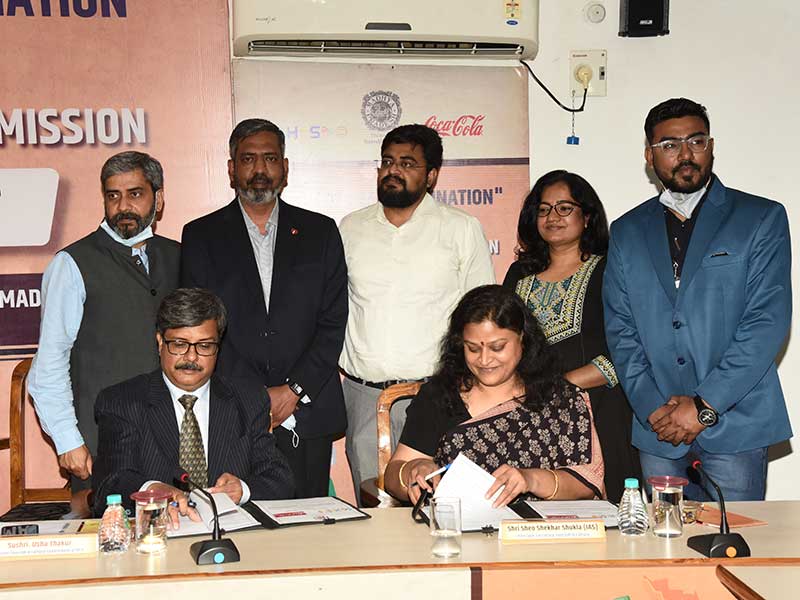
The Coca-Cola Foundation (TCCF) has provided a grant to Saahas, a non-profit organization working towards waste management, to set up sustainable waste management infrastructure in 30 villages around the Panna National Park in Madhya Pradesh next two years
The Coca-Cola Foundation (TCCF) has provided a grant to Saahas, a non-profit organization working towards waste management, to set up sustainable waste management infrastructure in 30 villages around the Panna National Park in Madhya Pradesh next two years.
By doing so, the TCCF joins the first-ever multi-stakeholder partnership to support the local government-run initiative towards waste management, along with the Ministry of Tourism, Madhya Pradesh, under their initiative ‘Clean Destinations’. The initiative also embraces India’s ‘Swachh Bharat’ mission to strengthen sustainable waste management across the country, especially in villages.
An MoU was signed today, in the presence of Hon’ble Governor Mr Mangubhai C. Patel; Smt. Usha Thakur from Minister of Tourism; Shri. Brajendra Pratap Singh, Minister Of Mineral Resources and Labour, Madhya Pradesh; Shri VD. Sharma, Member of Parliament, Khajuraho; Shri. Sheo Shekhar Shukla, Principal Secretary of Tourism Madhya Pradesh; Mr Sanjay Kumar Mishra, the District Collector; along with Mr Rajesh Ayapilla and Mr Rajiv Gupta from Coca-Cola India and South-West Asia.
Under the Responsible Tourism Mission, an innovative initiative Project ‘Clean Destination’ has been started by the Madhya Pradesh Tourism Board, Department of Tourism. Shri Sheo Shekhar Shukla, Principal Secretary, Tourism, informed that, in the first phase, the project would be started in 30 villages around Panna National Park. An MoU has been signed between the Madhya Pradesh Tourism Board and Bangalore based ‘Saahas’. The Coca-Cola Foundation (TCCF) has provided financial aid for the same.”
Ms Saadia Madsbjerg, President of TCCF, said, “We are proud to use our resources to fund initiatives for creating sustainable waste management solutions. And we are humbly confident that this grant will help repurpose waste effectively on our journey to drive progress in the Panna National Park region. TCCF and The Coca-Cola Company (TCCC) support achieving a World Without Waste (WWW), a bold, ambitious goal of achieving 100% collection and recycling by 2030. WWW signals a renewed focus on global sustainable waste management.”
Sonia Garga, Program Director, said, “Saahas is very excited to be part of this initiative, and we envisage that this project will become an example of sustainable waste management practices for national parks and natural tourist attractions. National parks pose some unique challenges due to their remote location and large waste generation by tourists. However, they also offer a great opportunity. The message of sustainable living can be conveyed very impactfully in these pristine surroundings. The parks can take this message far and wide through the large number of visitors coming from all over the country.
We look forward to contributing towards keeping our natural heritage clean and green!”
The key focus of this Solid Waste Management (SWM) program encompasses setting up infrastructure for waste collection and transportation systems, ensuring the creation of end destinations for all waste categories. Additionally, it incorporates Information, Education and Communication (IEC) and awareness campaigns to bring about awareness and behavioural change amongst tourists towards waste segregation and management.
Under this project, waste management infrastructure, including collection centres, will be set up for all 30 villages. This project will also provide motorized vehicles and pull carts throughout the project area for the collection and transportation of waste. Wet waste composting will also be set up for two larger villages, Madla and Hinauta. Separate colour-coded waste segregation bins will be placed at all prominent tourist spots and entry gates of the National Park.
The Madhya Pradesh Tourism Board will play a pivotal role in implementing the project, with different state government departments and institutions, including the Forest, Rural, Urban and Revenue department and the district panchayat office. The department has extended its immense support by providing land to set up collection infrastructure along with necessary civic amenities across 30 villages to ensure the sustainability of SWM systems.

Eminent CSR leaders discussed and reviewed the changes in the CSR Law under the chairmanship of Mr Sumant Chadha and after that came to a consensus that Corporate Social Responsibility (CSR) had gone a long way in instituting strategic programs to contribute toward causes
Eminent CSR leaders discussed and reviewed the changes in the CSR Law under the chairmanship of Mr Sumant Chadha and after that came to a consensus that Corporate Social Responsibility (CSR) had gone a long way in instituting strategic programs to contribute toward causes that enable the welfare of the society.
The amendments to the Companies Act, 2013 have defined organisations’ scope, helping strengthen the country socially and economically. Chadha said CSR had played a crucial role in supporting COVID-19 relief initiatives through contributions at multiple levels.
Others who attended included members of the Corporate Affairs Committee, including PK Rustagi, Ranjana Agarwal and Mr Sanjay Khanna, CS Devendra and V Deshpande.
Mr P K Rustagi highlighted in his address that there was a growing need for CSR after the coronavirus hit the world. He talked about the latest amendments in CSR. He said that COVID-19-related activity in the ordinary course of business can now be included as CSR along with the acquisition or creation of a capital asset provided that the company does not own it. He also said that any unspent CSR funds remaining at the end of a financial year should be transferred to an Unspent CSR Account or Transfer to a Schedule VII fund.
The value of a company is determined not only by its profits but also by sustainability, and CSR determines sustainability. Companies should not take CSR as a burden, CS Devendra and V Deshpande highlighted.
In his presentation, Mr Inder Mohan Singh gave a brief background and significant changes under the new CSR regime. He talked about the new CSR definition and said that constitution of the CSR committee has now been made optional. He also spoke about the concept of an ongoing project which is a new concept and was introduced on 22 January 2021.
Mr Sudhakar Saraswatula talked about the nuances and practical applications of CSR law. He said that the philosophy of giving back to society had been an integral part of the Indian culture and ethos, which has also been imbibed in traditional Indian businesses. He further said that the intent of CSR obligations is not merely to generate funds that additional taxes could have achieved and to involve companies to use their innovative ideas and management skills towards social development.
About the handling and implementation of various CSR projects and their impacts from the corporate point of view, Mr Ajay Holani said that the company should believe in integrating socio-economic development interventions within its core strategic business planning through its Corporate Social Responsibility.

Bosch Global Software Technologies (BGSW), formerly known as Robert Bosch Engineering and Business Solutions (RBEI), has partnered with Forests by Heartfulness to plant 25,000 saplings in a mini-forest plantation drive to celebrate its 25 years legacy in India
Bosch Global Software Technologies (BGSW), formerly known as Robert Bosch Engineering and Business Solutions (RBEI), has partnered with Forests by Heartfulness to plant 25,000 saplings in a mini-forest plantation drive to celebrate its 25 years legacy in India.
This multi-city plantation across Bangalore, Coimbatore and Hyderabad kicked off in February.
Speaking on the initiative, Mr RK Shenoy, SVP – Mobility Engineering and Member of Executive Leadership, BGSW, said, “This plantation drive marks our commitment to sustainability. BGSW focuses on improving the quality of life, and this is reflected in our commitment to developing new products and high-tech solutions that are intelligent, connected, and sustainable”.
“We are celebrating 25 years of our legacy in India and our recent rebranding to BGSW through an initiative that will leave an enduring positive impact for many decades to come. Globally, Bosch has taken many steps on sustainability and is one of the first to be Carbon neutral. BGSW has been driving many initiatives, including lake rejuvenation. This is one more small but sincere step in conserving and maintaining the planet’s ecological balance. Together with the local community, we can fight climate change and create a healthy environment for the next generation.”, he said.
President and Guide of Heartfulness Mr Kamlesh Patel said, ‘Forests by Heartfulness is our endeavour to create widespread awareness and enhance sustainable green cover for the future generations. The amount of flora that needs to be replenished for the natural ecosystem to be restored is not an overnight process, nor can it be a single entity initiative. It is a shared responsibility amongst various stakeholders – corporates, governments, NGOs, forestry, and individuals. We are greatly encouraged to see corporates’ interest in collaborating with this initiative towards actively building a green legacy. We congratulate Bosch Global Software Technologies (BGSW) towards taking up this large-scale multi-city mini-forest plantation drive across many cities marking their 25 years in India and commitment to sustainability.”
With 25,000 Sapling across Bangalore, Hyderabad and Coimbatore, this project focuses on improving biodiversity, creating a microclimate to abate city pollution, providing naturally grown fruits and medicinal herbs to the local communities, raising the local water table, and reducing at least 5,000 tonnes of carbon emission over the next ten years. BGSW, with their NGO partner, Heartfulness, will collaborate with local communities to take care of saplings and provide the necessary technology for geotagging and monitoring their growth for at least two years to ensure nutrient management.
The 25,000 saplings will be planted using Forests by Heartfulness proprietary Heartyculture High Density (HCHD) plantation method. This method involves extensive soil reconstitution using Activated Biochar, Vermicompost, Cow manure, and Cocopeat. BGSW will facilitate the plantation of over 100 different species of trees to create a mini forest. The trees selected for the plantation drive are native endemic and supported through an extensive root network.
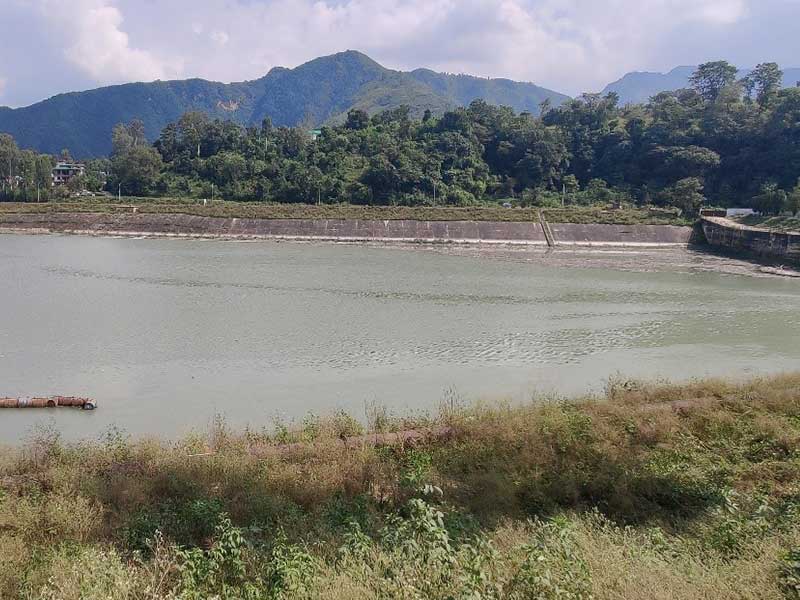
Cement giants, Ambuja Cements and ACC Limited, have jointly announced a mammoth project to remove plastic waste by commissioning its second phase of bubble barrier technology in BBMB Lake located in Sunder Nagar, Himachal Pradesh
Cement giants, Ambuja Cements and ACC Limited, have jointly announced a mammoth project to remove plastic waste by commissioning its second phase of bubble barrier technology in BBMB Lake located in Sunder Nagar, Himachal Pradesh. The cleaning project will be undertaken by the in-house waste management arm, Geocycle.
Bubble Barrier is an intelligent and non-invasive technology used to remove plastic from the water bodies, reducing the problem of marine plastic pollution in our country.
The CEO India Holcim and Managing Director cum CEO of Ambuja Cements. Neeraj Akhoury said, “We are committed to building a sustainable future by adopting clean and green technologies. Our efforts and expertise in co-processing have created a unique solution to sustainable disposal of the marine plastic waste that creates pollution. This initiative will also contribute towards promoting a circular economy. Taking this mission ahead, we will continue our efforts to implement this innovative technology across the country.”
The company has received a NOC from BBMB to install this innovative technology which will remove approximately 1500 tonnes per year of waste from the lake.
The BBMB Lake has been floating with light organic material, which has been accumulated over the years resulting in choking at the discharge point of the lake. The Company’s Geocycle Bubble Barrier technology will collect plastic and lighter materials like floating debris, organic wastes, etc., from the lake, thus reducing the chances of choking.
This technology has been installed in Himachal Pradesh with ACC Gagal Plant, which will serve as the co-processing centre for the plastic recovered from the lake. This project aims to co-process only a non-recyclable portion of the material collected, thus moving it to the existing waste disposal site of Sunder Nagar.
The recovered recyclable plastics will be sent to recycling facilities. In contrast, the non-recyclable plastics will be taken to Geocycle’s facility for pre-processing, then co-processing in ACC cement kilns at the Gagal plant.
The collection of plastics from leaking into the rivers will help the local community around the plant. Furthermore, the company has commissioned its pilot project in Agra, which has removed 500 tonnes of plastic waste from the Yamuna River. The company has recently received a NOC from Varanasi Municipal Corporation to install another bubble barrier technology.

Urban Company has partnered with Project Baala to distribute eco-friendly reusable pads among its female partners and raise awareness on menstrual wellness and hygiene. The aim is to target the economically marginalized sections of society who don’t have access to sanitary
Urban Company has partnered with Project Baala to distribute eco-friendly reusable pads among its female partners and raise awareness on menstrual wellness and hygiene. The aim is to target the economically marginalized sections of society who don’t have access to sanitary facilities.
Aimed to ensure every menstruator has access to affordable and sustainable practices, Urban Company is using its distribution channel to get Project Baala’s eco-friendly pads across Delhi NCR for now.
Project Baala has already conducted pan-India virtual workshops to educate and dispel myths and misinformation around menstruation. The feature-rich pads can be reused for up to two years, reducing plastic waste.
Commenting on the pilot project’s launch, Nikhil Shanker, VP – Customer Experience and Partner Experience at Urban Company, said, “We at Urban Company are committed towards the welfare and well-being of our partners. After speaking to Project Baala, we realized a huge gap between understanding menstrual wellness and hygiene and safe, sanitary practices. We are happy to have partnered with Project Baala and take a step towards creating sustainable and long-term impact for our female partners.”
Project Baala’s Outreach Head, Khushali Samriya, said, “For most of us, Urban Company service providers have been the immediate support for all our household services with and without the pandemic. As a menstrual hygiene organization, the least we aim to do is provide a long-term sustainable solution for their period needs. The combination of holistic menstrual awareness and sustainable product dissemination will fill up all knowledge gaps on menstrual health and provide tips on hygiene management, with a gradual non-subscription to myths. This is an extraordinary collaboration for us!”
The project is a part of Urban Company partner welfare initiatives. It comes on the heels of the company’s recent health awareness workshops conducted in collaboration with HCG Hospitals and, more recently, Max Healthcare. While the pilot phase focused on Delhi NCR for the distribution of sanitary kits, awareness workshops were conducted for all female partners across India.
Urban Company focuses extensively on partner livelihood through its skilling programs and other security benefits. All active partners on the UC platform in India are covered under the Group Life and Accidental Insurance cover, in partnership with ACKO. Some of the key aspects covered under the policy are life insurance (INR 6 lakhs), disability cover (INR 6 lakhs), accidental hospitalization (INR 70,000), accidental OPD treatment (INR 10,000) among others. Further, all UC Plus partners in India have access to additional health insurance benefits, which includes up to INR 2 lakh in-hospitalization treatment, room/ICU expenses, OPD, medical equipment and 12 free online doctor consultations in a year.
Committed to Skill India Mission, Honda Motorcycle and Scooter India Pvt. Ltd. (HMSI) has started Delhi’s third Skill Enhancement Centre at Malviya Nagar, collaborating with Government Industrial Training Institute (ITI), Delhi. The new centre became operational in February 2022
Committed to Skill India Mission, Honda Motorcycle and Scooter India Pvt. Ltd. (HMSI) has started Delhi’s third Skill Enhancement Centre at Malviya Nagar, collaborating with Government Industrial Training Institute (ITI), Delhi.
The new centre became operational in February 2022 and aimed at empowering local youth with job-oriented technical skill training in the city.
The inauguration was witnessed by top dignitaries of the industry and the government. These included O.P. Shukla (Joint Director Planning, Department of Training & Technical Education, Government of National Capital Territory of Delhi), BS Negi (Deputy Director Training, Department of Training & Technical Education, Government of National Capital Territory of Delhi), Vijay Kumar (Principal, Government Industrial Training Institute, Malviya Nagar, New Delhi), Rahul Sharan (Senior Manager – Skill Enhancement, Customer Service Technology & Customer Relations, HMSI) and other dignitaries from Honda Motorcycle and Scooter India Private Limited.
HMSI’s Skill Enhancement Centre at ITI Malviya Nagar has a fully functional workshop with two-wheelers and service infrastructure to give practical training to students on technical aspects of two-wheelers maintenance and repair. HMSI will also support recruitment opportunities to successful candidates at HMSI dealerships after completion of the training program.
Pradeep Pandey, Senior Vice President – Customer Service, Honda Motorcycle and Scooter India Pvt. Ltd., said, “Fulfilling our commitment to up-skill local youth and enhance their employability, we are proactively supporting the Skill India Mission to empower Indian youth. The BSVI emission norms have raised the demand for a skilled technical workforce in the automobile sector. Due to COVID-19 restrictions, students could not get hands-on practical training. HMSI’s third Skill Enhancement Centre in Delhi at Malviya Nagar will provide an improved facility to recoup for practical training while ensuring all safety protocols. Further, we will continue to inaugurate more centres in other parts of the country.”
Fulfilling its corporate social responsibility, HMSI has taken several initiatives in Skill Development. To bridge the requirement and availability of trained human resources in the automotive sector, HMSI is setting up Skill Enhancement Centres across India. Currently, HMSI operates 48 skill enhancement centres across 19 states in India.
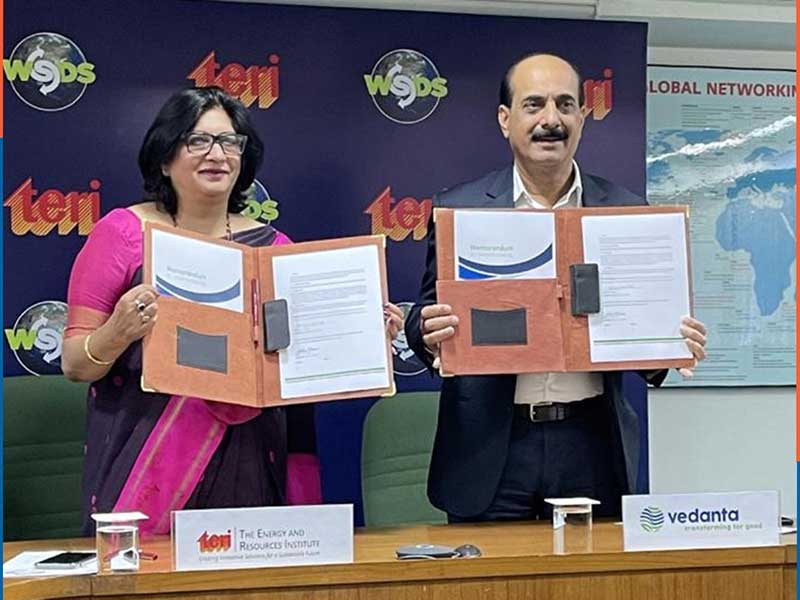
Vedanta has signed an MoU with TERI (The Energy and Resources Institute) to promote “Sustainable Use of Resources for a Resilient Planet through Transformative Actions”. The MoU was signed at the World Sustainable Development Summit (WSDS), where Prime Minister Narendra Modi
Vedanta has signed an MoU with TERI (The Energy and Resources Institute) to promote “Sustainable Use of Resources for a Resilient Planet through Transformative Actions”. The MoU was signed at the World Sustainable Development Summit (WSDS), where Prime Minister Narendra Modi delivered the inaugural address.
A global natural resources company, Vedanta is committed to the sustainable use of resources. At the same time, TERI, a multi-dimensional Not for profit organization (NPO), aims to create a sustainable world by leveraging both the organizations’ strength in the ESG space.
Vedanta plans to invest around ₹200 Cr over the next 5 to 10 years on R&D and sustainability initiatives to promote and build a sustainable ecosystem. The partners will create a sustainable future by engaging with governments, civil society and peers to encourage a more extensive ecosystem for climate change, resource efficiency, and circularity, harnessing cleaner energy, sustainable supply chains, and people-centric development.
TERI’s DG, Dr Vibha Dhawan, has said, “Businesses can play a paramount role in meeting development goals of the UN Development plan of 2030. Towards fulfilling this ambition, Vedanta and TERI have come together to work in the pursuit of solving pertinent issues that are critical towards achieving a sustainable future.”
Vedanta Group CEO Sunil Duggal said, “At Vedanta, we keep communities, people and planet at the centre of business decisions. We believe the partnership with TERI will create a larger ecosystem to support the global agenda of a sustainable world. This collaboration will help us traverse our ESG commitments on ‘Transforming for good’. TERI has a great track record of developing innovative and sustainable solutions in waste utilization, clean energy, resource efficiency and community welfare, which augurs well with our defined ESG aims. We aspire to work in tandem to achieve our common vision with this partnership.”
With this MoU, Vedanta and TERI will look at opportunities to work on common areas of interest until 2050. The partnership will provide a platform to promote individuals and organizations to adopt sustainable practices by creating Vedanta-TERI ESG awards and building a sustainable supply chain.
Vedanta is planning to be the ESG leader in the natural resources sector and has committed to reducing carbon emissions to zero by 2050 or sooner. The company has pledged $5 billion over the next ten years to accelerate the transition to net-zero operations. As part of the process, the company has repurposed its mission statement to Vedanta – ‘Transforming for Good’, to make a meaningful difference to society.