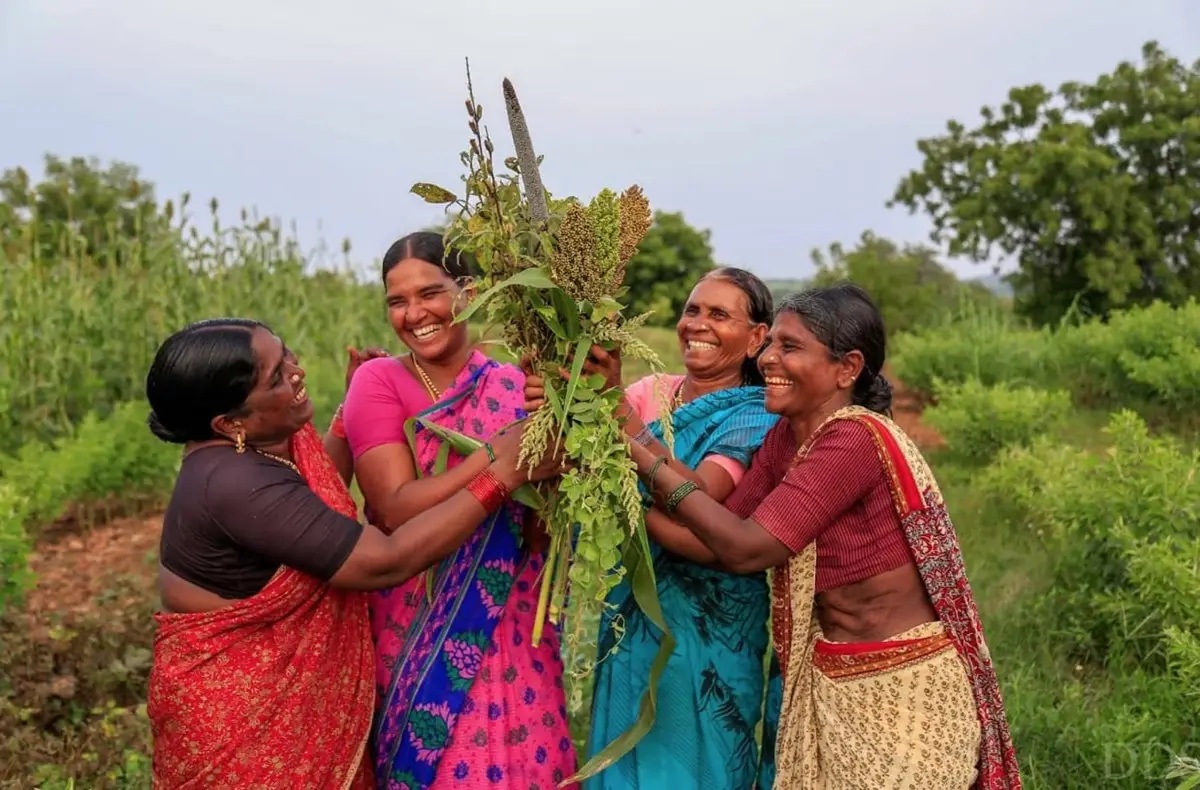
Maya Ghosh rises before dawn each day to oversee a network of collection centers that have transformed how women farmers in rural India sell their crops, cutting out middlemen who long controlled prices and profits.
“We used to sell our produce to middlemen who would decide the price. We had no voice, no choice,” said Ghosh, a director at Ken Betwa Mahila Farmer Producer Company Limited.
“Today, through our network of 34 collection centers, we’ve procured 448 metric tonnes directly from women farmers.” Ghosh is among thousands of women farmers whose livelihoods have improved through farmer producer companies (FPCs) – agricultural collectives that pool resources, share knowledge, and negotiate better prices for members.
The initiative, run by non-profit SRIJAN with funding from the Walmart Foundation, expanded its shareholder base nearly fourfold to 24,328 women farmers between November 2022 and November 2024, with women comprising 88% of members.
Average annual incomes for shareholders rose by 30,000 rupees (USD357), a 51% increase, while collective turnover across 12 FPCs grew more than 190% during the two-year period, SRIJAN said.
BREAKING BARRIERS
In villages where women farmers traditionally had limited say in agricultural decisions, they now occupy leadership positions and negotiate directly with buyers.
“The first time I stood up in a meeting to speak, my hands were shaking,” said Savitri Yadav, who serves on the management committee of her FPC in the eastern state of Bihar. “Today, when traders come, they negotiate with us on our terms.”
The model has proven particularly effective in eliminating intermediaries. Some 88% of shareholders now purchase farming inputs through their FPCs, while 39% sell produce directly through the collectives, according to project data.
For Kamla Devi, a smallholder farmer in Uttar Pradesh state who joined her local FPC in 2023, the benefits were immediate. “My children can now go to school without me worrying about fees,” Devi said.
“I bought quality seeds through our FPC and learned new farming techniques. My yield doubled, and I got a fair price when I sold through our collective.”
WALMART FOUNDATION EXPANDS SUPPORT
Building on initial success, SRIJAN is launching a second phase with new grant support from the Walmart Foundation that will expand the program to 38,000 women farmers across 19 FPCs.
“We are committed to fostering a more inclusive, efficient, and profitable FPC ecosystem – one centered around agricultural production and greater participation of women farmers in the value chain,” said Prasanna Khemariya, chief executive officer of SRIJAN.
The expansion focuses on ensuring FPCs can operate independently without external support, with all 19 companies expected to achieve self-sufficiency. Training programs aim to help 70% of participating women farmers adopt improved crop management practices.
“Empowering women farmers is central to building resilient agricultural economies,” said Nishant Gupta, social and environmental impact advisor to Walmart.org, the Walmart Foundation’s philanthropic arm.
“We are pleased to support SRIJAN’s efforts to enhance market access, boost capacity building, and increase women farmers’ participation in the agri-value chain.”
CHANGING PERCEPTIONS
The program’s impact extends beyond economics, reshaping how younger generations view agriculture as a career. Priya Sharma, 23, recently completed her university degree and returned to her village to join her mother’s FPC rather than seeking urban employment – a decision that would have been unusual just years earlier.
“I saw what my mother achieved – the respect she earned, the income she generated,” Sharma said. “Agriculture doesn’t mean poverty anymore. It means opportunity.”
At Ghosh’s collection center in Madhya Pradesh state, younger women farmers now weigh produce, negotiate prices, and manage accounts on tablets – tasks that were once dominated entirely by men and middlemen.
“We’re not just growing crops,” Ghosh said. “We’re growing confidence. We’re growing communities. We’re growing a future where our daughters won’t have to leave their villages to find dignity and success.”
India has approximately 146 million farmers, with women farmers comprising a significant portion of the agricultural workforce though often lacking formal recognition or direct market access, according to government data.