Tag: #Sustainability

  • KCG, Urbaser sign moU for waste management drive

    KCG, Urbaser sign moU for waste management drive

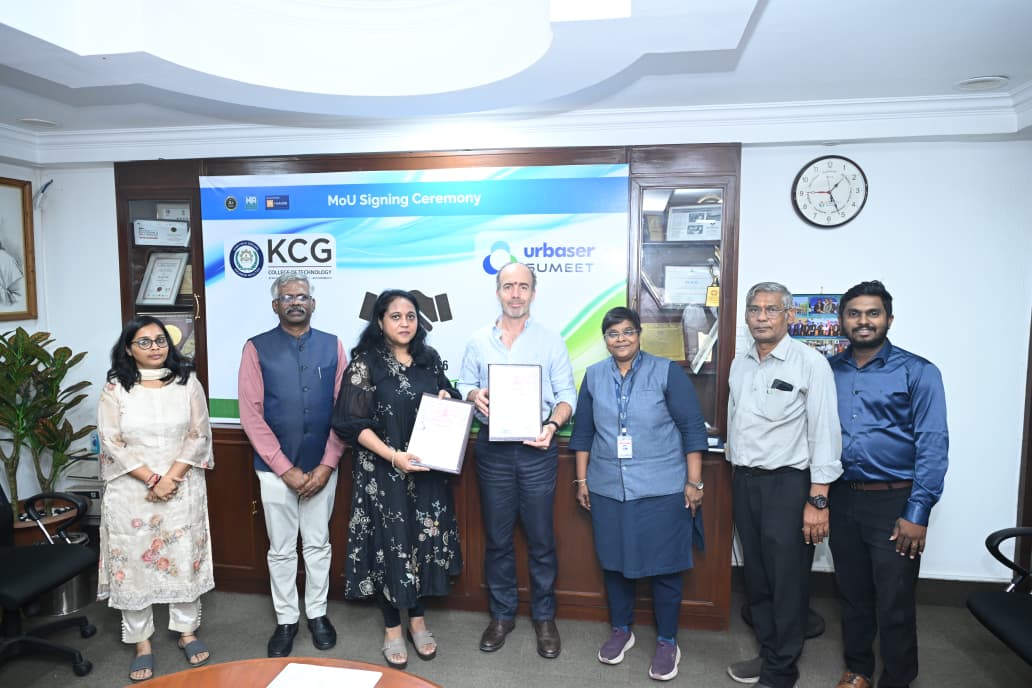
    KCG College of Technology, a unit of the Hindustan Group of Institutions, has signed a transformative Memorandum of Understanding with Sumeet Urban Services (Chennai) V Pvt Ltd, known as Urbaser Sumeet, to deepen industry-academia collaboration in waste management, sustainability and skill development.

    The partnership aims to build a long-term, industry-integrated sustainability model that directly engages students in solving real-world urban environmental challenges across Chennai.

    Under the agreement, students will participate in clean-up drives, waste management awareness campaigns, sustainability workshops, internships and innovation challenges. The collaboration will also cover hackathons, practical training and professional certification programmes focused on circular economy practices and environmental sustainability.

    A key initiative under the MoU is “Edubridge,” a programme designed to support the education and empowerment of children of frontline conservancy workers — a measure both institutions described as central to social inclusion and community impact.

    Urbaser Sumeet will also serve as the hygiene partner for major institutional events at KCG, demonstrating best practices in source segregation, solid waste management and urban cleanliness systems.

    “Engineering education today must go beyond laboratories and classrooms,” said Anand Jacob Varghese, Chairman, Hindustan Group of Institutions. “When our students walk alongside conservancy workers, manage waste drives and design recycling solutions for their own city, they are not just learning — they are becoming the kind of engineers and citizens Chennai needs.”

    Annie Jacob, Director of KCG College of Technology, said embedding Urbaser Sumeet’s operational expertise into campus programmes would give students direct exposure to one of Chennai’s most critical urban services. “From internships in waste vehicle operations to the Edubridge initiative, this collaboration is built around real impact — not just awareness,” she said.

    Albert Gleiser Ignacio, Managing Director of Urbaser Sumeet, said lasting change in urban waste management begins with how the next generation thinks about it. “Partnering with KCG gives us the opportunity to bring that ground reality into an academic setting and build a pipeline of professionals genuinely invested in sustainable urban systems,” he said.

    The partnership is expected to generate research-oriented projects in waste segregation, recycling systems, circular economy models and smart urban sustainability solutions. Both organisations said they intend to develop a scalable and replicable model for sustainable campus-community partnerships.

    The collaboration promotes the principles of Reduce, Reuse and Recycle and seeks to foster environmentally conscious practices across the student community and beyond.

  • Hitachi Vantara cuts client energy use with sustainable data infrastructure

    Hitachi Vantara cuts client energy use with sustainable data infrastructure

    Hitachi Vantara, the data storage and hybrid cloud subsidiary of Hitachi Ltd, published its FY2025 Sustainability Report on Thursday, outlining measurable energy and cost reductions achieved by clients using its latest sustainable data infrastructure platforms, as surging AI workloads reshape the economics of enterprise computing.

    The report arrives as the International Energy Agency warns that global data center electricity consumption could surpass 1,000 terawatt-hours by 2026 — roughly equivalent to a major industrialized nation’s annual usage — driven in large part by artificial intelligence workloads that demand constant, high-performance storage and processing.

    “Sustainability is increasingly tied to operational performance and business outcomes. In FY2025, we focused on helping customers manage the growth of AI and data while improving efficiency and reducing environmental impact,” said Akinobu Shimada, CEO, Hitachi Vantara in a statement.

    Among the report’s most striking findings: Turkish retail bank DestekBank achieved a 25% reduction in data center energy consumption after deploying Hitachi Vantara’s VSP One Block platform, alongside a 35% jump in application performance and a 20% drop in total cost of ownership. Belgian water utility Aquiris, which processes more than 110 million cubic meters of wastewater annually, credited the same platform with lowering its carbon footprint while collecting over one million data points per day for process monitoring.

    Indian media company Malayala Manorama reported the sharpest operational gains, cutting data center rack space by 66% and achieving 70% savings in power and cooling costs after modernising its infrastructure to support round-the-clock print, broadcast and digital operations.

    On the product side, the company introduced the VSP One Block High End, engineered to reduce power and cooling requirements for enterprise and AI-driven workloads. Hitachi Vantara also expanded lifecycle assessments across its VSP One Block, File and Object portfolios and launched its Clear Sight dashboard, giving customers direct visibility into energy consumption and carbon usage. The firm reported that up to 50% recycled content now appears in key components, and that less than 0.3% of materials were sent to landfill.

    Governance improvements included strengthened emissions tracking across Scope 1, Scope 2 and key Scope 3 categories, aligned with science-based reduction targets and evolving ESG reporting standards.

  • DS Group achieves landmark water positive certification, joins elite corporate circle

    DS Group achieves landmark water positive certification, joins elite corporate circle

    Dharampal Satyapal Group (DS Group), one of India’s leading FMCG conglomerates, has earned Water Positive Certification from GRIHA (Green Rating for Integrated Habitat Assessment), recording a Water Positivity Index of 1.80 — placing the company among a select few Indian corporations to achieve such a high score.

    The certification, awarded under GRIHA’s Decarbonizing Habitat Programme, follows a two-and-a-half-year assessment across 30 business locations in India, covering divisions spanning food and beverage, mouth freshener, hospitality, and agriculture.

    Scale of Impact

    Conservation interventions by DS Group have created a cumulative water storage potential of 66 lakh kilolitres. The programme integrates rainwater harvesting structures, wastewater reuse systems, recharge wells, water-efficient fixtures, and ecological restoration measures. Projects in Rajasthan and Madhya Pradesh contributed significantly to groundwater recharge outcomes.

    “The whole world is moving rapidly towards sustainability, with global water demand projected to exceed supply by 40% by 2030,” said Rajiv Kumar, Vice Chairman of DS Group.

    “By embedding water-positive practices into our business and community initiatives, DS Group contributes meaningfully to the larger sustainability agenda that India is aiming for.”

    Kumar added that the Group views sustainability “not as a project but as a permanent responsibility,” guided by its philosophy of ‘Create What is Worth Creating.’

    Sanjay Seth, VP and CEO of GRIHA Council and Senior Director at TERI, called the certification “a statement of intent of responsibility and vision,” adding that DS Group had demonstrated that “sustainability, productivity and profitability can go hand in hand.”

    Broader Sustainability Context

    The Water Positive Certification adds to a wider sustainability programme at DS Group that spans water conservation, livelihood development, agricultural initiatives, and energy efficiency. The company’s headquarters holds both LEED Platinum and LEED Zero Carbon certifications from the U.S. Green Building Council.

    The achievement comes ahead of COP30, where water security and climate resilience are expected to be central agenda items.

    Founded in 1929, DS Group markets brands including Rajnigandha, Catch, Pulse, Pass Pass, LuvIt, and L’Opera across domestic and international markets.

    Established in 2007 as a joint initiative between Ministry of New and Renewable Energy and TERI, GRIHA operates as India’s nationally recognised green building rating system and is referenced in India’s Nationally Determined Contributions to the UNFCCC.