Tag: #GreenIndia

  • DS Group achieves landmark water positive certification, joins elite corporate circle

    DS Group achieves landmark water positive certification, joins elite corporate circle

    Dharampal Satyapal Group (DS Group), one of India’s leading FMCG conglomerates, has earned Water Positive Certification from GRIHA (Green Rating for Integrated Habitat Assessment), recording a Water Positivity Index of 1.80 — placing the company among a select few Indian corporations to achieve such a high score.

    The certification, awarded under GRIHA’s Decarbonizing Habitat Programme, follows a two-and-a-half-year assessment across 30 business locations in India, covering divisions spanning food and beverage, mouth freshener, hospitality, and agriculture.

    Scale of Impact

    Conservation interventions by DS Group have created a cumulative water storage potential of 66 lakh kilolitres. The programme integrates rainwater harvesting structures, wastewater reuse systems, recharge wells, water-efficient fixtures, and ecological restoration measures. Projects in Rajasthan and Madhya Pradesh contributed significantly to groundwater recharge outcomes.

    “The whole world is moving rapidly towards sustainability, with global water demand projected to exceed supply by 40% by 2030,” said Rajiv Kumar, Vice Chairman of DS Group.

    “By embedding water-positive practices into our business and community initiatives, DS Group contributes meaningfully to the larger sustainability agenda that India is aiming for.”

    Kumar added that the Group views sustainability “not as a project but as a permanent responsibility,” guided by its philosophy of ‘Create What is Worth Creating.’

    Sanjay Seth, VP and CEO of GRIHA Council and Senior Director at TERI, called the certification “a statement of intent of responsibility and vision,” adding that DS Group had demonstrated that “sustainability, productivity and profitability can go hand in hand.”

    Broader Sustainability Context

    The Water Positive Certification adds to a wider sustainability programme at DS Group that spans water conservation, livelihood development, agricultural initiatives, and energy efficiency. The company’s headquarters holds both LEED Platinum and LEED Zero Carbon certifications from the U.S. Green Building Council.

    The achievement comes ahead of COP30, where water security and climate resilience are expected to be central agenda items.

    Founded in 1929, DS Group markets brands including Rajnigandha, Catch, Pulse, Pass Pass, LuvIt, and L’Opera across domestic and international markets.

    Established in 2007 as a joint initiative between Ministry of New and Renewable Energy and TERI, GRIHA operates as India’s nationally recognised green building rating system and is referenced in India’s Nationally Determined Contributions to the UNFCCC.
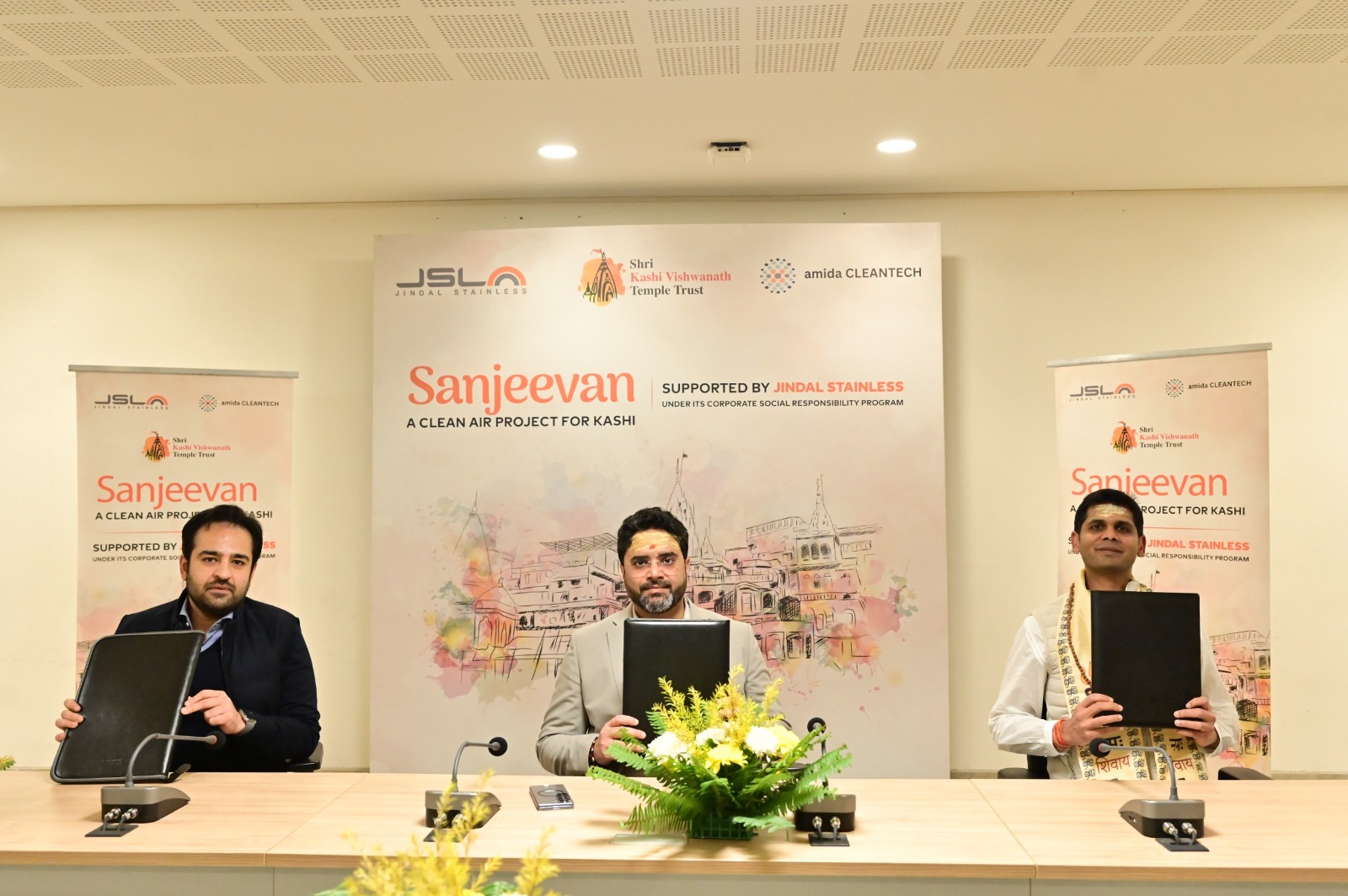
  • Jindal Stainless deploys Sanjeevanair purification to cleanse smoke-laden skies above Manikarnika ghat

    Jindal Stainless deploys Sanjeevanair purification to cleanse smoke-laden skies above Manikarnika ghat

    Jindal Stainless Limited, India’s leading stainless steel manufacturer, has launched Sanjeevan air purification at the Shri Kashi Vishwanath Dham (SKVD) complex in Varanasi, marking the company’s single largest corporate social responsibility initiative to date.

    The breakthrough project targets the dense particulate haze generated by burning funeral pyres at the adjacent Manikarnika Ghat, one of Hinduism’s most sacred cremation sites.

    The programme is being executed in partnership with Amida Cleantech Private Limited (AMIDA), whose proprietary ACE+ technology — independently verified by NITI Aayog — forms the operational backbone of the system. Fifty-eight stainless-steel purification units, installed on the SKVD Ramp Building that flanks Manikarnika Ghat, collectively process more than 3,00,000 cubic metres of ambient air per hour.

    How ACE+ Works

    The acronym ACE stands for Attract, Capture, and Eliminate. The system is engineered to neutralise a broad spectrum of airborne contaminants: nano-black carbon, pollens, organic particulate matter ranging from 100 nanometres to 50 microns, sulphur oxides (SOx), nitrogen oxides (NOx) from vehicular traffic, and microbial pathogens including viruses and bacteria. The technology’s multi-pollutant capability addresses the compounded burden of cremation smoke, temple-corridor exhaust fumes, and biological aerosols — all converging at one of India’s most densely visited religious sites.

    “By improving air quality at Shri Kashi Vishwanath Dham, we aim to enhance the environment for both local residents and the millions of devotees who visit this revered landmark. Our collaboration with Amida Cleantech showcases our support for innovative Indian technology while driving meaningful change.” Jindal Stainless said in a statement.

    Alignment With National Policy

    The Sanjeevan air purification initiative is formally aligned with the National Clean Air Programme (NCAP) launched by India’s Ministry of Environment, Forest and Climate Change, which mandates measurable reductions in particulate pollution at the city, regional, and national level. SKVD authorities have formally approved the installation, a sanction that both companies regard as a critical enabling step for future rollouts at similarly congested heritage sites.

    Amida Cleantech said the system is designed to capture a significant portion of cremation emissions at their source, and to reduce measured PM concentrations along the temple corridor — protecting pilgrims, resident priests, and the ornate stone façades of the SKVD’s historic buildings from accelerated chemical weathering caused by acidic smoke deposits.

    Broader Significance

    Analysts note that Manikarnika Ghat conducts cremations around the clock, 365 days a year, meaning continuous emission loads uncommon at most pollution hotspots. Deploying a validated, scalable ambient purification system in such a demanding environment could serve as a proof-of-concept for other heritage and high-density religious sites across India. Sanjeevan air purification, if it meets its stated targets, would represent a replicable model bridging cultural heritage preservation, public health, and clean-tech commercialisation.

    Both Jindal Stainless and AMIDA were commended by local authorities for their commitment to the project. Amida Cleantech, whose guiding principle is “The Air You Breathe,” said ACE+ innovations are being positioned to address escalating ambient pollution across diverse high-exposure sectors — from industrial corridors to dense urban precincts.