Category: Tech and Innovation

  • Vodafone India Foundation launches digital literacy portal for marginalised communities

    Vodafone India Foundation launches digital literacy portal for marginalised communities

    Vodafone India Foundation, the CSR arm of mobile service provider Vodafone Idea, today launched a portal ‘Digisakshar.org’ to help marginalised communities become digital literate and self-reliant. The portal, which has ben developed

    Vodafone India Foundation, the CSR arm of mobile service provider Vodafone Idea, today launched a portal ‘Digisakshar.org’ to help marginalised communities become digital literate and self-reliant.

    The portal, which has ben developed in partnership with IT and business consulting services firm CGI and NASSCOM Foundation, was launched at a virtual event.

    In addition to offering digital literacy to communities, Vodafone India Foundation said that the self-learning portal also drives them towards better job and entrepreneurship opportunities helping them become self-reliant.

    The web platform curates personalized content from different sources in Hindi and English and will soon also be available in Kannada, Oriya and Marathi.

    The free to use portal provides over 40 courses in both Hindi and English, designed for all age groups and curated to cover basic, intermediate and advanced knowledge on digital skills, it said in a statement.

    The courses range from basics of computer operations, handling mobile phones, using internet securely, digital payments, finding jobs and livelihood opportunities, accessing common and government websites and many more.

    Vodafone India Foundation launches digital literacy portal for marginalised communities

    According to Vodafone India Foundation, NASSCOM Foundation has program managed the creation of the portal, while the CGI will be developing self-learning content in multiple languages to augment the digital skills curriculum.

    Commenting on the intiative, Vodafone Idea Ltd Chief Regulatory and Corporate Affairs Officer P Balaji said the company has transformative initiatives in the domains of agriculture, education, health, women empowerment which are positively impacting millions of Indians every year.

    “Today, as part of our commitment to increase digital literacy and help communities learn digital skills, I am delighted to announce launch of Digisakshar – which I am sure will contribute to a resilient and skilled India,” he said.

    NASSCOM Foundation CEO Ashok Pamidi said, “With digital literacy through physical centres taking a huge hit due to the current crisis, Digisakshar hopes to provide a safe online learning environment for Digital Novices to learn new skills.”

    CGI Asia Pacific Global Delivery Centers of Excellence President George Mattackal, CSC e-Governance Services India CEO Dinesh Tyagi, and National Skill Development Corporation (NSDC) Head Learning Resources and Technology Preet Arora were among others present at the launch.

  • OPPO India to honour 120 innovators for creative solution to tackle COVID-19

    OPPO India to honour 120 innovators for creative solution to tackle COVID-19

    Chinese handset maker OPPO today announced a new initiative in India for honouring 120 innovators who have adopted some out-of-the-box ideas to tackle the COVID-19 pandemic. The initiative called Salute to the Ultimate 120 with the Power of Change

    Chinese handset maker OPPO today announced a new initiative in India for honouring 120 innovators who have adopted some out-of-the-box ideas to tackle the COVID-19 pandemic.

    The initiative called “Salute to the Ultimate 120 with the Power of Change” is in collaboration with Forbes India.

    “This initiative is a testament to salute those leaders who are helping people help each other and offer creative solutions to tackle the pandemic,” the company said in a statement.

    Forbes India will come out with four special issues. Each issue will be centred on each of the four pillars – Innovation, endurance, performance, and style and highlight the creative minds of influencers.

    The same will be featured on other platforms in a video format to highlight the contribution. As part of this collaboration, OPPO has also felicitated the influencers with their recently launched Find X2 Pro smartphone, it added.

  • Karnataka tops the Innovation Index followed by TN, Maha and Delhi

    Karnataka tops the Innovation Index followed by TN, Maha and Delhi

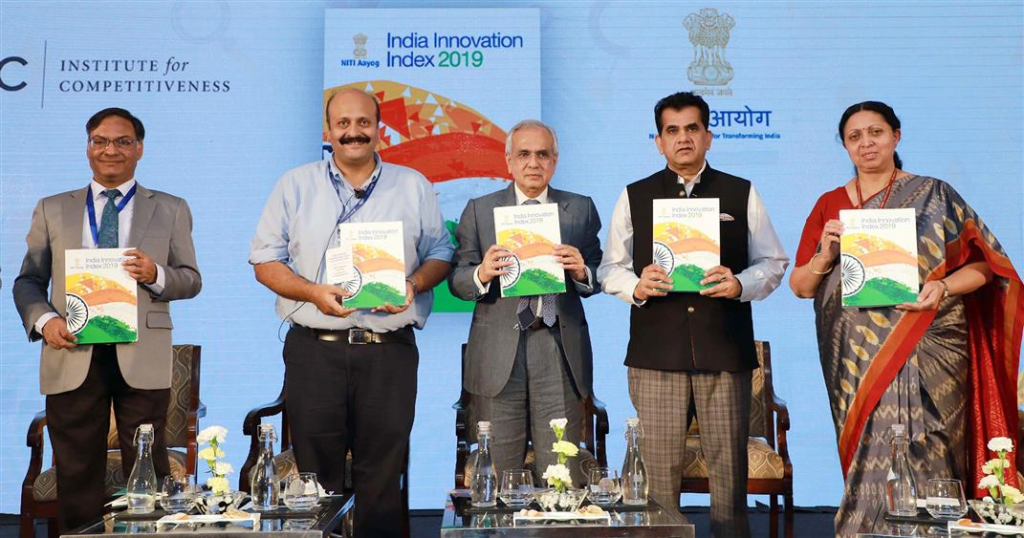
    NITI Aayog with Institute for Competitiveness as the knowledge partner released the India Innovation Index (III) 2019. Karnataka is the most innovative major state in India. Tamil Nadu, Maharashtra, Telangana, Haryana, Kerala, Uttar Pradesh, West Bengal, Gujarat, and Andhra Pradesh form the remaining

    NITI Aayog with Institute for Competitiveness as the knowledge partner released the India Innovation Index (III) 2019. Karnataka is the most innovative major state in India. Tamil Nadu, Maharashtra, Telangana, Haryana, Kerala, Uttar Pradesh, West Bengal, Gujarat, and Andhra Pradesh form the remaining top ten major states respectively. The top ten major states are majorly concentrated in southern and western India. Sikkim and Delhi take the top spots among the northeastern & hill states, and union territories/city-states/small states respectively. Delhi, Karnataka, Maharashtra, Tamil Nadu, Telangana, and Uttar Pradesh are the most efficient states in translating inputs into output.

    The index was released in the presence of Dr Rajiv Kumar, Vice Chairman, NITI Aayog; Amitabh Kant, CEO, NITI Aayog; Ashutosh Sharma, Secretary, Department of Science; Renu Swarup, Secretary, Department of Biotechnology and Vaidya Rajesh Kotecha, Secretary, AYUSH.

    Dr Rajiv Kumar expressed hope that “the India Innovation Index would create synergies between different stakeholders in the innovation ecosystem and India would shift to competitive good governance.” Shri Amitabh Kant added that “India has a unique opportunity among its myriad challenges to become the innovation leader in the world.” Renu Swarup said, “cluster-based innovation should be leveraged upon as the focal point of competitiveness.” Shri Ashutosh Sharma said, “The index is a great beginning to improve the environment of innovation in the country as it focuses on both the input and output components of the idea.” Shri Vaidya Kotecha said, “The index is a good effort to benchmark the performance of the state with each other and promote competitive federalism.”

    The study examines the innovation ecosystem of Indian states and union territories. The aim is to create a holistic tool which can be used by policymakers across the country to identify the challenges to be addressed and strengths to build on when designing the economic growth policies for their regions. The states have been bifurcated into three categories: major states, north-east, and hill states, and union territories/city-states/small states.

  • Reskilling can help navigate the slowdown

    Reskilling can help navigate the slowdown

    India is expected to grow at 7.7 per cent by 2019-20, rising from 7.2 percent in 2017-18, according to recent studies. With the ever-evolving technological landscape, businesses around the world have experienced a rapid change of skill needs and requirements. This has given rise to another issue in

    India is expected to grow at 7.7 per cent by 2019-20, rising from 7.2 percent in 2017-18, according to recent studies. With the ever-evolving technological landscape, businesses around the world have experienced a rapid change of skill needs and requirements. This has given rise to another issue in the country: a broadening skills gap.

    According to recent studies, the Asia-Pacific region is likely to face a shortage of 12.3 million workers by 2020, with the opportunity cost amounting to USD 4.2 trillion. Technological development, including blockchain, artificial intelligence, data science, and machine learning, are bringing major changes across industries. Skilling and reskilling will help employees navigate through the technological changes taking place across industries and workplaces, according to HR experts. Graduates need to be trained in new skills and technologies that organizations presently seek.

    As per HR expert Zairus Master, CEO,Shine.com. Today, jobs demand familiarity and expertise in disruptive technologies like Augmented/Virtual Reality, blockchain, cybersecurity, Artificial Intelligence (AI), Machine Learning, 5G, and the Internet of Things (IoT). Institutes and colleges are still producing engineers with the same skills that their predecessors had more than a decade ago. As a result, there is a huge mismatch between demand and supply in terms of a skilled workforce. There is a critical need for more dedicated reskilling and upskilling initiatives aimed at getting the Indian workforce ready for the jobs of tomorrow.